Ready to Schedule Your Visit?
Take the next step toward feeling better.
Request your appointment online or call our office at (720) 400-7025 to get started today.

When traditional antidepressants haven’t provided the relief you need, alternative depression treatments offer new hope. At Axis Integrated Mental Health, our psychiatric team specializes in innovative, evidence-based therapies for treatment-resistant depression, including Deep TMS therapy and ketamine treatment (Spravato). Serving patients in Aurora, Denver, Boulder, and Westminster, we provide personalized alternative treatment plans that address the unique needs of those who haven’t found success with conventional approaches. Book an appointment with a provider in 7 days or less or schedule a free consultation today to see how much alternative depression treatments cost.
Treatment-resistant depression (TRD) affects approximately 30% of people with major depressive disorder, according to research published in the Journal of Clinical Psychiatry. This condition occurs when someone doesn’t respond adequately to at least two different antidepressant medications taken at therapeutic doses for sufficient duration. Many individuals experience partial improvement but continue to struggle with persistent symptoms like emotional numbness, fatigue, and lack of motivation.
TRD is defined as an inadequate response to at least two antidepressants at therapeutic doses. When medications fail, alternative treatments that work through different brain mechanisms may provide meaningful relief.
The frustration of trying multiple medications without lasting results is real and valid. Traditional antidepressants work by targeting serotonin and other neurotransmitters, but depression involves complex brain circuits that may require different therapeutic approaches. Alternative depression treatments work through novel mechanisms that can provide relief when conventional medications have failed.
Research from Frontiers in Neuroscience shows that innovative treatments like TMS and ketamine can help with depression when medications fail. These alternatives don’t just mask symptoms – they can actually help rewire brain circuits associated with mood regulation, providing more fundamental and lasting change.
Book a free financial consultation with our expert Rachel!
At your appointment, we’ll tell you:
Ask Rachel about payment plans, alternative payments, and more on your call.
Deep TMS therapy uses targeted magnetic pulses to stimulate specific brain regions involved in mood regulation. Unlike medications that affect your entire body, TMS directly targets the prefrontal cortex, where depression-related brain activity patterns can be modified.
How TMS Works: During treatment, a magnetic coil is placed against your scalp near the forehead. Magnetic pulses stimulate nerve cells in the brain region that controls mood, activating areas that are typically underactive in depression. Each session lasts about 20 minutes, and you remain awake and alert throughout the process.
TMS Treatment Schedule: A typical course involves daily sessions Monday through Friday for 4 weeks, followed by a tapering schedule of twice a week for 8 weeks. Many patients begin noticing improvements after 2-3 weeks of treatment. Axis Integrated Mental Health does offer Saturday appointments as well for busy professionals.
TMS Effectiveness: Clinical studies show that 82% of people with treatment-resistant depression experience significant improvement with TMS, and 65% achieve complete remission. The FDA has approved TMS for major depression, and it’s covered by most insurance plans.
Side Effects: TMS is well-tolerated with minimal side effects. The most common side effect is mild scalp discomfort during treatment, which typically diminishes after the first few sessions. Unlike antidepressants, TMS doesn’t cause weight gain, sexual side effects, or cognitive problems.
Ketamine therapy represents a revolutionary approach to treating depression by targeting the brain’s NMDA receptors rather than serotonin systems. This unique mechanism can provide rapid antidepressant effects, often within hours or days rather than weeks.
Ketamine treatment modality: Spravato is the FDA-approved ketamine-derived nasal spray. Also called “esketamine”, it is derived from ketamine and specifically indicated for treatment-resistant depression and major depressive disorder with suicidal ideation.
Spravato vs. Traditional Ketamine: While both work through similar mechanisms, Spravato is administered as a nasal spray and has specific FDA approval for treatment-resistant depression. The treatment protocol is standardized, and covered by insurance while traditional ketamine therapy through intravenous, intramuscular, or lozenge administration is not. In terms of efficacy, clinical studies show Spravato to be more effective than ketamine infusions, however, few large scale, standardized head to head studies exist.
Treatment Process: Spravato is administered twice weekly for the first four weeks, then weekly or every other week based on your response. Each session is conducted in our clinic with medical supervision, as required by FDA guidelines.
Clinical Results: Studies show that up to 79% of people with treatment-resistant depression experience meaningful improvement with Spravato. The treatment can be particularly effective when combined with an oral antidepressant.
Insurance Coverage: Most major insurance plans cover Spravato for FDA-approved indications, making it an accessible option for many patients who have struggled with treatment-resistant depression. At Axis Integrated Mental Health, we accept most major insurance plans and work with you to understand your benefits before starting treatment. For detailed information about what your specific plan covers, visit our comprehensive insurance guides including Aetna, Anthem BCBS, Cigna, Denver Health Medicaid and POS+ Plans, United Healthcare, and Colorado Medicaid. Therapy sessions are typically covered with a copay ranging from $20 to $60, while advanced treatments like Spravato can cost as little as $10 per visit for eligible patients. If you’re pursuing drug-free options like TMS without first trying antidepressants, you may face higher out-of-pocket costs since insurance companies often require documentation of failed medication trials before approving coverage. We believe cost should never be a barrier to getting the help you need, which is why our team will work with you to explore all available coverage options and payment plans.
The following chart summarizes the efficacy and remission rates for the FDA-approved alternative treatments available:
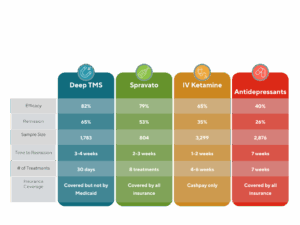
Depression Treatment Options Efficacy and Remission Rates
Beyond innovative medical treatments, our alternative depression therapy includes evidence-based integrative approaches that address the whole person, not just symptoms.
Growing research shows that nutrition plays a crucial role in mental health. Our integrative approach may include:
Pharmacogenomic testing can identify how your body processes different medications, helping explain why certain antidepressants may not have worked effectively. This information guides more personalized treatment selection and dosing strategies.
Psychotherapy with or without alternative depression treatments, has strong research support for preventing depression relapse. When combined with innovative treatments like TMS or ketamine therapy, therapy can help maintain and extend treatment benefits. We not only have therapists in-house, we also have an extensive network of local therapists we work with to ensure that patients are matched appropriately for the issues they are dealing with and with therapists with lived experience.
Our Denver-based team has extensive training in alternative depression treatments and stays current with the latest research and techniques. Every provider at our clinic has had extensive experience treating patients with different forms of depression. For instance, Frani Rhodes has a Masters of Science Nursing, Women’s Health Care Nurse Practitioner from the University of Colorado Health Sciences, as well as being a PMHNP. Our provider Elinor O’Buckley once worked for Janssen Pharmaceuticals and was involved with the launch of its REMS program, including its prescribing requirements, medication administration requirements, site and patient registration, monitoring requirements, contraindications, and documentation. Our providers are experts with lived experience with depression as you can see from their individual provider interviews.
We understand the unique challenges faced by individuals who haven’t responded to traditional antidepressants. Our approach is compassionate, evidence-based, and focused on finding solutions that work for your specific situation and working collaboratively with your care team to provide you with the best outcomes.
Rather than offering one-size-fits-all solutions, we develop personalized treatment plans based on your history, symptoms, and treatment goals. This might include:
Our Denver Tech Center, Aurora, Boulder, and Westminster locations feature comfortable, private treatment rooms designed specifically for alternative therapies. All Deep TMS, ketamine, and Spravato treatments are conducted in medically supervised environments with the latest safety protocols and monitoring equipment.
We work extensively with insurance providers to maximize coverage for alternative depression treatments. Our team helps with:
Your journey begins with a comprehensive evaluation where we review your complete treatment history, assess current symptoms, and discuss your goals for recovery. This typically includes:
Once we’ve developed your treatment plan, we begin with close monitoring and regular check-ins:
Week 1-2: Treatment initiation with baseline measurements and close monitoring for early response signs.
Week 3-4: Assessment of initial response and treatment adjustments as needed.
Week 5-8: Continued treatment with ongoing optimization based on your response and any side effects.
Month 2-6: Maintenance phase with regular monitoring and treatment adjustments to sustain improvements.
Alternative depression treatments often provide rapid initial relief, but maintaining those gains requires ongoing support:
“My treatment is Spravato and I started with two times a week and the most immediate thing I noticed after my second time was that I actually wanted to be here I didn’t want to be gone from this world and that has continued over the whole year that I’ve been doing the Spravato treatments” Danielle, Axis patient
“The staff there always made me feel like they really cared about me that’s really important in a medical setting that um I interact with people who make me feel like a person cuz I’ve been through that of people who don’t really see me and that’s always a really really rough time so interacting people who I felt really cared about me was so so important with my treatment” Megan, Axis patient
A study across 1,753 real-world patients focusing on treatment-resistant major depressive disorder showed:
In a recent study of 853 patients,
TMS Safety: TMS has been extensively studied with an excellent safety profile. The most common side effect is temporary scalp discomfort. Serious side effects like seizures are extremely rare (less than 0.1% of patients).
Ketamine Safety: When administered in a medical setting by trained professionals, ketamine therapy is very safe. Temporary dissociative effects are normal and resolve quickly. Blood pressure is monitored throughout treatment. We do not recommend at-home ketamine due to safety.
Spravato Safety: As an FDA-approved medication with strict administration protocols, Spravato has well-documented safety data. The REMS (Risk Evaluation and Mitigation Strategy) program ensures safe administration in certified healthcare settings.
Many patients worry about the cost of alternative treatments, but insurance coverage has improved significantly:
TMS Coverage: Most major insurance plans cover TMS for treatment-resistant depression after documenting failure of adequate antidepressant trials.
Ketamine Coverage: Ketamine is almost never approved for coverage as a depression treatment by insurance companies. We work with patients to explore all payment options.
Spravato Coverage: As an FDA-approved treatment, Spravato is covered by most insurance plans for appropriate candidates provide patients have tried 2 or more antidepressants in the past (depending on the insurance plan).
Alternative treatments do require a time investment, but we work with busy professionals to make treatment accessible:
Alternative depression treatments are evidence-based therapies that work through different mechanisms than traditional antidepressants. The most effective options include TMS (Transcranial Magnetic Stimulation), ketamine therapy, and Spravato (esketamine). These treatments target different brain pathways and can provide relief for people who haven’t responded to conventional antidepressants. Unlike medications that affect neurotransmitters throughout the body, these alternatives work by directly stimulating brain circuits involved in mood regulation or blocking specific receptors to promote rapid neuroplasticity.
TMS uses magnetic pulses to stimulate underactive brain regions associated with depression, particularly the left prefrontal cortex. This stimulation helps normalize brain activity patterns over the course of treatment. Ketamine works by blocking NMDA receptors in the brain, which triggers a cascade of molecular changes that promote new neural connections and can rapidly reverse depression symptoms. Both treatments can provide benefits when traditional antidepressants have failed because they target different biological mechanisms. TMS has a 60-70% response rate in treatment-resistant depression, while ketamine shows response rates of 70-80% with rapid onset of effects.
Most major insurance plans cover TMS therapy for treatment-resistant depression after documenting failure of adequate antidepressant trials. Spravato is also widely covered as an FDA-approved treatment for treatment-resistant depression while any other form of ketamine therapy in Colorado is not. Our insurance team helps verify coverage, obtain prior authorizations, and appeal denied claims when appropriate. We also offer payment plans and work with patients to make innovative treatments accessible regardless of insurance limitations.
If you’ve tried multiple antidepressants without success, you’re not alone – this affects about 30% of people with depression. Alternative treatments like TMS and Spravato are specifically designed for treatment-resistant cases and work through completely different mechanisms than traditional medications. Many patients who haven’t responded to 2-3+ antidepressants find significant relief with these innovative approaches. We also use genetic testing to understand why previous medications may not have worked and guide more personalized treatment selection. The key is not to give up hope – breakthrough treatments offer new possibilities for recovery.
Alternative treatments typically work much faster than traditional antidepressants. Spravato can provide noticeable improvement within 24-72 hours, with many patients experiencing significant benefits after 2-3 treatments. TMS therapy usually begins showing effects after 2-3 weeks of treatment, which is still faster than the 4-8 weeks required for most antidepressants. However, individual responses vary, and some people may notice improvements sooner or later. The rapid onset of these treatments can provide hope and momentum for recovery when you’ve been struggling for months or years with ineffective medications.
If you’re tired of living with depression that hasn’t responded to traditional treatments, alternative therapies offer new hope for lasting recovery. At Axis Integrated Mental Health, our Colorado-based team specializes in innovative, evidence-based treatments that can provide relief when conventional approaches have failed.
Don’t let treatment-resistant depression define your life. Our compassionate specialists understand the frustration of trying multiple medications without success, and we’re here to help you explore breakthrough alternatives that can make a real difference.
Ready to explore alternative depression treatments? Take the first step toward recovery today.
Schedule your consultation online at axismh.com/book-online or call our Denver office at 720-400-7025 to discuss your alternative treatment options with our specialized team.