When someone in crisis reaches out for help at 2 a.m., every second counts. But most mental health practices can’t staff phones around the clock, and traditional voicemail fails patients at their most vulnerable moments.
Axis Integrated Mental Health co-founder Liesl Leary-Perez faced this reality directly. With a background in generative AI and a deep commitment to mental health access, she asked a question many practice owners are now facing: How do you scale care without losing the human connection? That required a different approach.
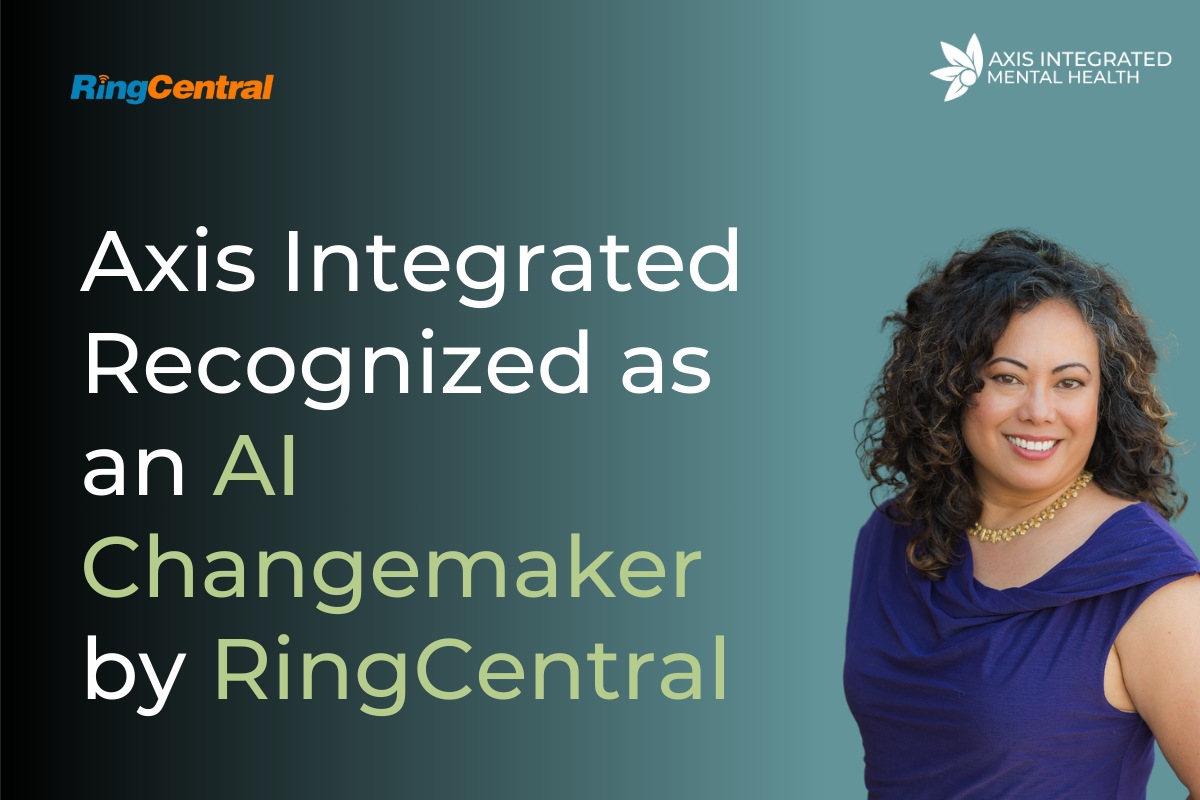
The results recently earned recognition from RingCentral as an AI Changemaker: 60% increase in new patient intakes, $1.7 million in projected revenue, and 32% calls now being handled by RingCentral AI Receptionist (AIR) allowing staff to spend more time on complex patient needs.
But the real achievement is what those numbers represent. 266K Coloradans at risk of suicide now have access to immediate support, even in the middle of the night.
This article shares what we learned implementing AI in a real mental health practice, including what worked, what didn’t, and what any practice should consider before adopting voice AI technology.
How AI Will Transform Healthcare in 2026
Healthcare practices nationwide face the same challenge: rising demand, limited staff, and impossible 24/7 access without burnout or budget breaks.
AI emerges as a practical solution. Here’s why:
1. Voice AI Becomes Essential for Crisis Response
Healthcare companies, hospitals, and privately-owned clinics will consider adopting Voice AI because people at high risk need urgent support. Modern voice agents understand natural language, manage crises, and direct people to appropriate treatment before situations escalate.
Axis’s implementation with RingCentral’s AI Receptionist, affectionately named “Charlotte”, provides a real world example. Charlotte handles multiple calls simultaneously, provides immediate information, and routes urgent cases to on-call clinicians, ensuring no crisis call goes unanswered.
2. AI Helps Clinics Understand Patient Needs
One of AI’s most powerful capabilities in healthcare is pattern recognition across massive datasets. RingSense helps to understand call patterns and the types of issues patients are calling about, which allow us to reduce operational friction, and serve patients better.
For practices implementing voice AI, this means the technology learns and improves over time. When a person in distress speaks to an AI assistant like Charlotte by RingCentral, the receptionist can route calls efficiently to a team member, or send a text to our live calendar for routine questions about scheduling. For depression treatment in Denver, where the demand for high-quality care outstrips supply, being able to apply the right interventions at the right time can make the difference between life or death.
Axis’s RingSense data also helps us understand what FAQ content needs to be created to rank higher in AI search. What started as a simple call answering system evolved into an intelligent triage and content tool that gets smarter with each interaction.
3. AI Enhances Front Desk Staff Skills While Reducing Burnout
Healthcare’s workforce crisis continues. Staff burnout, especially among administrative teams handling repetitive inquiries, contributes to costly turnover. The question isn’t whether to use AI, but how to implement it effectively.
Successful implementations treat AI as a rapid decision making engine, allowing front desk staff to focus on answering complex and emotionally sensitive issues while supporting more routine functions through Charlotte. The AI receptionist has not replaced jobs. In fact, Axis has added more staff to the front desk team since its implementation. What it has done is remove a lot of the tedious, repetitive aspects of the job and improved job satisfaction and retention. When staff aren’t overwhelmed by repetitive questions, they can train the AI through their experience, improving responses over time. And they can be more emotionally responsive to people who truly need to talk with a knowledgeable and empathetic person about their situation.
Axis’s clinical administrator Alexis Gonzalez shared that setup took just one day: “We focused on creating rules based on the existing call history. That was just from monitoring the call history and inputting rules based on common questions.”
“Its ability to handle multiple calls simultaneously has substantially reduced our missed calls,” explains Liesl in RingCentral’s AI Changemaker Case Study. “We’re now at a 91% answer rate.”
The Real World Test: Supporting 266K Coloradans at Risk
Colorado ranks among the lowest states for adult and youth mental well-being despite its progressive reputation. Adult mental health plummeted to #48 in the nation in 2025 and we still rank #50 of all states for the prevalence of mental illness. In 2025, the number of adults with serious thoughts of suicide rose from 266,000 to 282,000, ranking us #47 of all states for this grim statistic.
Mental health crises don’t follow business schedules. When someone finally musters courage to call for help, every answered phone call, even if it’s by an AI receptionist telling them that someone will call them in the morning, can make a difference.
Before implementing AI, Axis struggled with dropped calls, frustrated patients, and burned out staff managing traditional IVR and call center systems.
After implementing RingCentral’s AI Receptionist, new patient intakes jumped 60%, contributing $1.7 million in projected revenue. Missed calls which at one point was nearly half of all calls dropped to less than 10%.
What Didn’t Work Initially
Not everything succeeded immediately. The AI struggled with pronunciation of provider names and mental health terminology. Staff worried technology would feel impersonal. There were valid concerns about situations beyond AI training.
Solutions require ongoing work and training: pronunciation guides for names and medications, escalation protocols routing high risk calls to humans instantly, and feedback systems letting staff improve responses continuously. Knowing that their knowledge would help other clinics reach more patients faster, Axis Integrated Mental Health even shared some of its initial AI training protocols with clinics in other states.
The lesson? AI implementation isn’t one time setup. It’s an ongoing partnership between technology and people who understand patients best.
What Practice Owners Should Consider Before Implementing AI
The decision to implement AI requires balancing technology investment with staff training, patient experience with efficiency, and innovation with the human nature of mental healthcare. But practices that get it right gain significant advantages.
The Economic Reality
Labor costs account for 56% of operating expenses and continue rising while reimbursement rates fail to keep pace. Traditional solutions like hiring more staff hit financial limits quickly. AI offers a different path, capturing revenue through reduced missed calls, lowering turnover from administrative burden, and extending access beyond manual staffing capacity.
The Axis experience shows ROI can appear within weeks. But the real value lies in improved patient outcomes and staff satisfaction.
Making AI Work
- Start small and define clear goals. Reduce missed calls? Extend hours? Free up staff time? Different objectives require different approaches.
- Involve your team from day one. Staff who help train the AI become champions. Staff who feel replaced will sabotage it.
- Choose integrated technology. The one day implementation Axis achieved happened because RingCentral integrated with existing systems rather than replacing everything.
- Plan for refinement. First versions have gaps. Build feedback loops for continuous improvement.
Moving Forward With AI in Mental Healthcare
The recognition Axis Integrated Mental Health received as a RingCentral AI Changemaker validates an approach that many practice owners are considering: using technology to expand access and improve efficiency without losing the human connection that makes mental healthcare effective.
Supporting nearly 300K Coloradans at risk of suicide requires innovation at every level. For practice owners exploring AI and operational innovation: The Practice Power Workshop on January 17, 2026 offers practical insights on implementation, partnership models, and lessons learned from real deployments.
The complete AI Changemaker case study featuring Axis Integrated Mental Health provides additional detail on implementation, challenges, and results.
Additional Resources
- Alternative Depression Treatments in Denver
- Deep TMS Therapy Costs and Insurance Coverage
- Spravato Treatment Guide
- Premier Partner Program Details
- Women’s Depression Treatment Services
- The 266 Project: Supporting Colorado’s Mental Health
Frequently Asked Questions
How does AI improve mental health crisis response?
AI powered voice assistants answer calls simultaneously and can detect if a patient needs routine support which can be handled through text, or route urgent cases to human team members.
What makes a mental health practice stand out in 2026?
Combining advanced treatments like Deep TMS and Spravato with 24/7 AI access creates significant differentiation. Insurance acceptance including Medicaid removes financial barriers. Axis in Denver, Boulder, and Westminster exemplifies this approach, earning RingCentral’s AI Changemaker recognition for technology that enhances rather than replaces human connection. Explore partnership opportunities making advanced treatments accessible without massive investment.
How can practices implement AI without losing the personal touch?
Use AI for administrative tasks like scheduling and basic questions while keeping humans central to clinical care. Successful implementations involve staff from the beginning, using their expertise to train AI on realistic scenarios. Many practices complete setup in one or two days with integrated systems. The principle: AI augments human capability rather than replacing it. Explore implementation strategies at the Practice Power Workshop.
What advanced options exist for treatment resistant depression?
Spravato (esketamine) nasal spray offers rapid symptom reduction, often within hours to days. Deep TMS therapy uses magnetic pulses to stimulate brain regions, typically showing results within 4 to 6 weeks without medication side effects. Both work through different mechanisms than traditional antidepressants, explaining their success when other approaches haven’t worked. Most major insurance plans cover these when clinical criteria are met. Access is expanding across Denver, Aurora, Boulder, Westminster and other Colorado communities for comprehensive depression treatment.
How can independent practices access advanced treatment capabilities?
Partnership models let smaller practices offer sophisticated treatments without six figure equipment and technology investments. These arrangements provide access to advanced protocols, shared training, collective insurance negotiating power, and referral networks. Independent practices maintain their identity while gaining capabilities usually reserved for large systems. Colorado has seen growth in these models. Explore options like the Premier Partner Program or contact Axis Integrated Mental Health if you’d like to start differentiating your practice with our advanced treatments.