Where does Colorado rank for mental health? If you’re a Coloradan watching our state languish near the bottom of national mental health rankings year after year, you’re not alone in feeling frustrated. The newest data from Mental Health America’s 2025 State of Mental Health in America report ranks Colorado 41st out of 51 (the 50 states plus D.C.). It’s a slight improvement from last year’s 46th place, but still dangerously low for a state that prides itself on health and outdoor living.
Diving deeper into the data shows that improvement is almost entirely because kids are doing better. According to Mental Health America’s latest report, Colorado’s youth mental health ranking jumped from 47th to 31st this year, a major gain that helped pull our overall rank to 41st (up from 46th last year). But adults are moving the opposite direction: our adult mental health ranking slid from 40th to 48th, placing Colorado near the very bottom for adult well-being. In other words, while there’s hope in how youth services and awareness are improving, adult mental health is worsening, keeping Colorado’s overall picture bleak.
A Look Back: A Volatile Five Years
Colorado’s mental health standing has swung dramatically:
| MHA Report Year (Data Year Range) | Overall Rank (Out of 51) | Adult Rank | Youth Rank | Prevalence Rank | Access Rank | Key Context |
|---|---|---|---|---|---|---|
| 2020 (2016–2017 Data) | 29 | 33 | 34 | 44 | 17 | Middle of the pack; relatively strong access but rising needs. |
| 2021 (2017–2018 Data) | 47 | 48 | 42 | 48 | 31 | Major decline. Moved into the worst category (39–51) across all metrics. |
| 2022 (2018–2019 Data) | 37 | 51 | 44 | 45 | 21 | Slight improvement overall, but ranked dead last (51st) for adult mental health. |
| 2023 (2019–2020 Data) | 30 | 45 | 13 | 33 | 26 | Snapshot Year: Data not comparable to previous years due to methodological changes during COVID-19. |
| 2024 (2021–2022 Data) | 46 | 40 | 44 | 50 | 17 | Snapshot Year: Not comparable to pre-2021 trend. High youth and prevalence concerns. |
| 2025 (2022–2023 Data) | 41 | 48 | 31 | 50 | 14 | Comparable to 2024 data. Ranked near the bottom again, driven by high prevalence. |
*2023 and 2024 rankings aren’t directly comparable to earlier years because MHA changed its methodology after the COVID-19 data break.
In plain terms: Colorado hovered around the middle of the pack until a major drop in 2021, hit rock bottom for adult mental health in 2022 (dead last), rebounded a bit in 2023, then slid back to near the bottom for prevalence in 2024 and 2025.
Brutal Reality: Why Colorado Keeps Failing
Let’s be blunt about what’s happening here.
- We Have the Second-Highest Mental Illness Rates in America
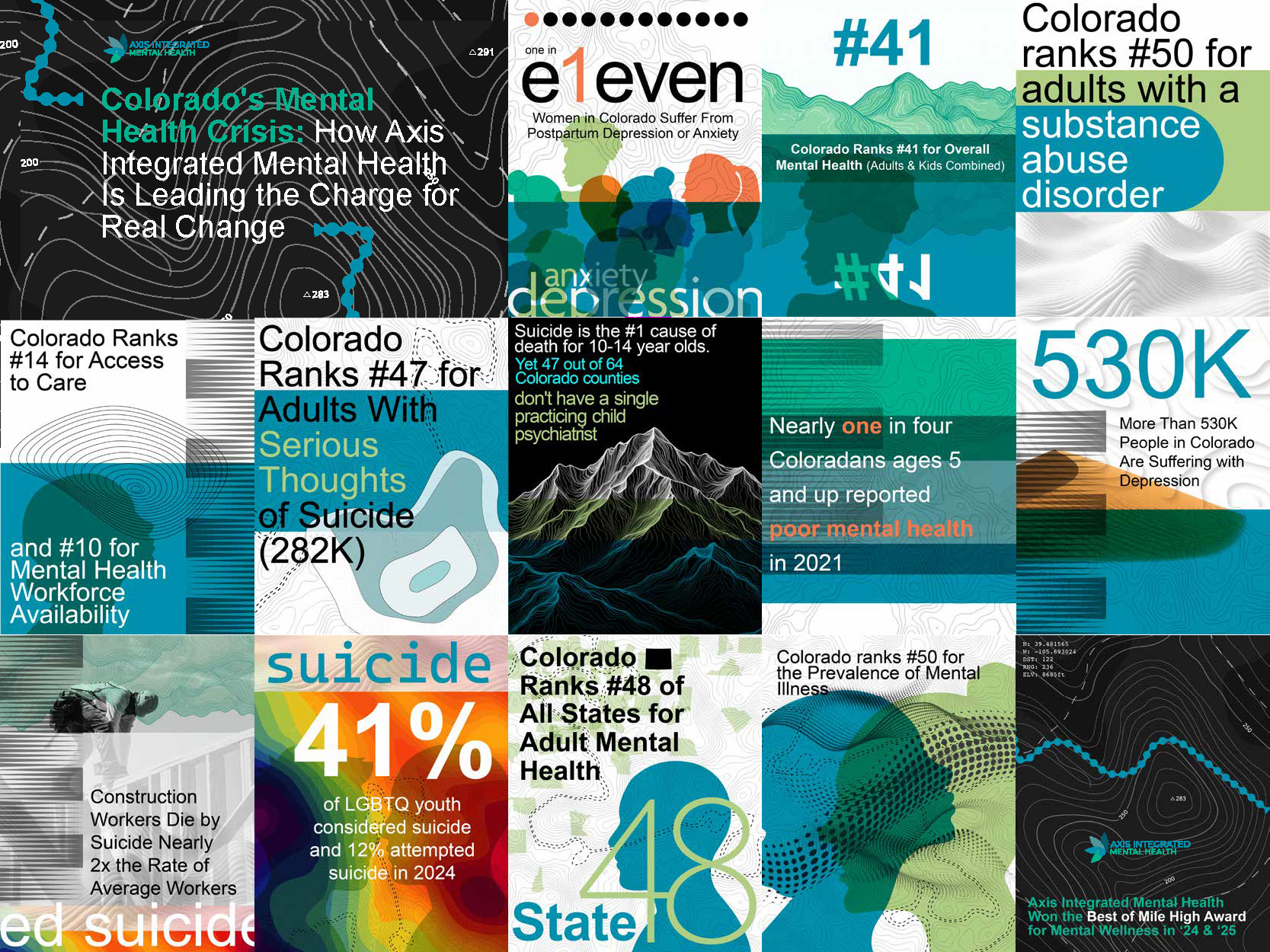
Colorado doesn’t just have a mental health problem; we have a mental health crisis. As of 2024, we have the second-highest prevalence of mental illness in the United States. In 2025’s rankings, we placed 50th for overall prevalence, meaning more Coloradans are struggling than in nearly every other state except for Oregon.- Colorado ranks #47 for adults with serious thoughts of suicide (282K)
- Colorado ranks #48 of all states for Adult Mental Health
- #50 for the Prevalence of Mental Illness
- Colorado ranks #50 for adults with a substance abuse disorder
- 1 in 11 women in Colorado suffer from postpartum depression or anxiety
- Construction workers die by suicide nearly 2x the rate of average workers
- Suicide was the #1 cause of death for 10–18 year olds between 2015-2019, yet 47 out of 64 Colorado counties don’t have a single practicing child psychiatrist
- 41% of LGBTQ youth considered suicide and 12% attempted suicide in 2024
- It’s not because we lack resources. Colorado ranks #14 for access to care and #10 for mental health workforce availability.
- Mountain communities face a “Paradise Paradox”: places like Aspen and Telluride experience suicide rates two to three times the national average due to isolation, lack of care, and financial instability.
- Kids Can’t Find Help When They Need It Most
While Colorado’s youth ranking improved to 31st this year (up from 44th) and 22% of Colorado High School students report persistent feelings of sadness or hopelessness (down from 40% in 2021), the crisis for young people remains acute.- 47 out of Colorado’s 64 counties don’t have a single practicing child and adolescent psychiatrist.
- High rates of major depressive episodes and suicidal ideation persist, and preventive care gaps delay screening and referral until crisis points.
- Good Insurance Doesn’t Mean Good Care
Colorado ranks 14th nationally for insurance access, but coverage doesn’t guarantee care.- 2.9 million Coloradans live in mental health professional shortage areas.
- Nearly half cited stigma as the reason they didn’t get needed mental health care.
- In Denver, 65.6% of people who didn’t get treatment cited cost concerns in 2021.
- 43% of insured Coloradans who skipped needed care worried their insurance wouldn’t cover mental health services.
- Rural and frontier counties often have no Medicaid providers billing for behavioral health services.
- Adults in Boulder/Broomfield who needed care but didn’t get it increased from 10% (2016) to 17% (2021).
- Even when providers exist, many don’t take insurance, have long waitlists, or fragment care across therapy, psychiatry, and advanced treatments.
The tragedy of this situation is that advanced treatments like Spravato esketamine therapy often include savings programs that can reduce costs to as little as $10 per visit, and Axis helps with prior authorization, but many people give up long before we can explain what a deductible is.
- The System Is Built to Fail
Despite creation of the Behavioral Health Administration in 2022, thirteen state departments still distribute behavioral health funding as of FY 2025. This bureaucracy makes efficient resourcing and structural change difficult. Patients face a labyrinth with no map. - Colorado’s Per Capita Mental Health Spending Is Below Average
Between fiscal year (FY) 2022 and FY 2025, Colorado is projected to spend $8.5 billion on behavioral health. While this may seem like a meaningful outlay, it is far below what other states spend per person. For example, Maine remains the national leader, investing over $345 per person in state mental health services. In contrast, Colorado’s state mental health agency spent $67.67 per person in FY2024 (up from $63.76 in FY2023). That puts us in 27th place for spending per person (we’re number 47th if measuring per capita) well behind several higher-spending states. These gaps matter: when states invest more per resident, they can fund more clinics, shorten waitlists, and expand crisis and community services. - Colorado is Facing New Challenges with Legalized Online Gambling
Since the launch of legal sports betting in 2020, Colorado’s annual wagering significantly increased from $2.3 billion to $6.3 billion. Public health experts estimate 1 in 20 will develop a gambling addiction problem. This represents a new challenge that Colorado’s mental health system is not even ready for.
The Axis Difference: Profits Don’t Come Before Patients
Patient-First, Always
We’re not a venture capital-backed corporation answering to shareholders in New York or Chicago. We’re a locally rooted organization invested in Colorado communities. Every decision starts with one question: what will actually help this patient get better?
That’s why we’ve built an integrated, team-based care model connecting therapy, psychiatry, and advanced treatments under one roof. No more bouncing between disconnected providers or falling through the cracks.
Making Advanced Treatments Actually Accessible
Too many Coloradans are labeled “treatment-resistant” and left to suffer. Axis specializes in proven, cutting-edge treatments that can be game-changers for those who haven’t found relief through traditional approaches:
- Deep TMS (Transcranial Magnetic Stimulation): FDA-cleared and non-invasive; uses targeted magnetic pulses to stimulate mood-regulation areas. Clinical studies show response rates as high as 82% and remission over 65% for depression not helped by medications. We work to maximize insurance coverage so cost doesn’t block access.
- Spravato (Esketamine): For severe depression with suicidal thoughts, Spravato can reduce suicidality rapidly. We guide patients from insurance authorization through safe, monitored administration.
The difference between Axis and profit-driven competitors? We fight to make these treatments accessible. We navigate insurance, offer payment options, and persist through denials. We measure success in lives changed, not quarterly earnings.
Partnering for Change: Our Premier Partners Program
Improving outcomes takes more than one clinic. Our Premier Partners Program supports patients and providers across Colorado with:
- Proven growth playbooks, co-branded marketing, and hyperlocal PR support
- Exclusive events to build community and share knowledge
- Direct introductions to specialists for better care coordination
This builds a network united to tackle Colorado’s crisis together, expanding access to advanced treatments and strengthening the ecosystem of care.
Our Commitment to Colorado: Philanthropy in Action
- We accept insurance and plans many national chains reject.
- We have donated over $400K in pro bono services and were recognized by the Denver Business Journal as a Partner in Philanthropy.
- We provide proactive insurance navigation to secure approvals for advanced treatments.
- We invest in community education and outreach, especially in underserved areas.
- We support workforce development through our new grad program.
- We partner with local organizations because the problem is bigger than any single clinic.
We’re not just treating individuals. We’re working to strengthen the entire mental health ecosystem. When one Coloradan gets better, families heal, workplaces improve, and communities grow stronger.
What Real Change Looks Like
Colorado’s improvement from 46th to 41st proves progress is possible, but adults are clearly struggling. Climbing out of this crisis requires more than incremental change. It demands a fundamental reimagining of care delivery. States that improve focus on:
- Comprehensive, integrated, team-based care models
- Proactive insurance navigation and advocacy
- Advanced treatment options beyond daily pills (Deep TMS, Spravato, and more)
This isn’t theory. This is the Axis model in action every day.
This Is About Lives, Not Numbers
Behind the rankings are real people: the teenager in Grand Junction who can’t find a psychiatrist, the construction worker in Denver fighting silent demons who can’t go on pills, the mother who’s too depressed to get prenatal care, the veteran who’s tried six medications without relief.
Untreated mental illness destroys families and communities. It leads to suicide, addiction, job loss, and community crises. Every day someone goes without proper care is a day we fail as a state.
Colorado has the resources, talent, and will to fix this. We need organizations willing to do the hard, patient-centered work and more Coloradans demanding better. We need people to ask “who owns your clinic?” and intentionally choose to go to clinics owned and operated by Coloradans.
If You’re Struggling, Help Is Here
Whether you’re facing your first depressive episode or have battled mental illness for years, you don’t have to do this alone. If traditional treatments haven’t worked or you’re not sure where to start, there is a path forward.
- Call or text 988 for immediate crisis support.
- Call or text Axis Integrated Mental Health at 720.400.7025 or book online for personalized, integrated care. We’ll help you navigate insurance, explore options including Deep TMS and Spravato, and build a coordinated care team focused on your healing.
Because in a state ranked 41st for mental health, someone has to lead the way back up. That’s the work we’re committed to, one patient, one family, one life at a time.
The Bottom Line
Colorado moved up five places, but we’re still in crisis. The difference between where we are and where we need to be won’t come from faceless corporations chasing profits. It will be made by organizations like Axis Integrated Mental Health that put Coloradans first. The question isn’t whether we can improve. It’s whether we have the courage to demand better and support the people doing the real work to make it happen.
Your mental health matters. Your loved one’s mental health matters. Your life matters. And we’re here to prove it.
Download full image Where Does Colorado Rank for Mental Health? (Vertical – 8.7MB)
Download full image Where Does Colorado Rank for Mental Health? (Landscape – 2.7MB)