
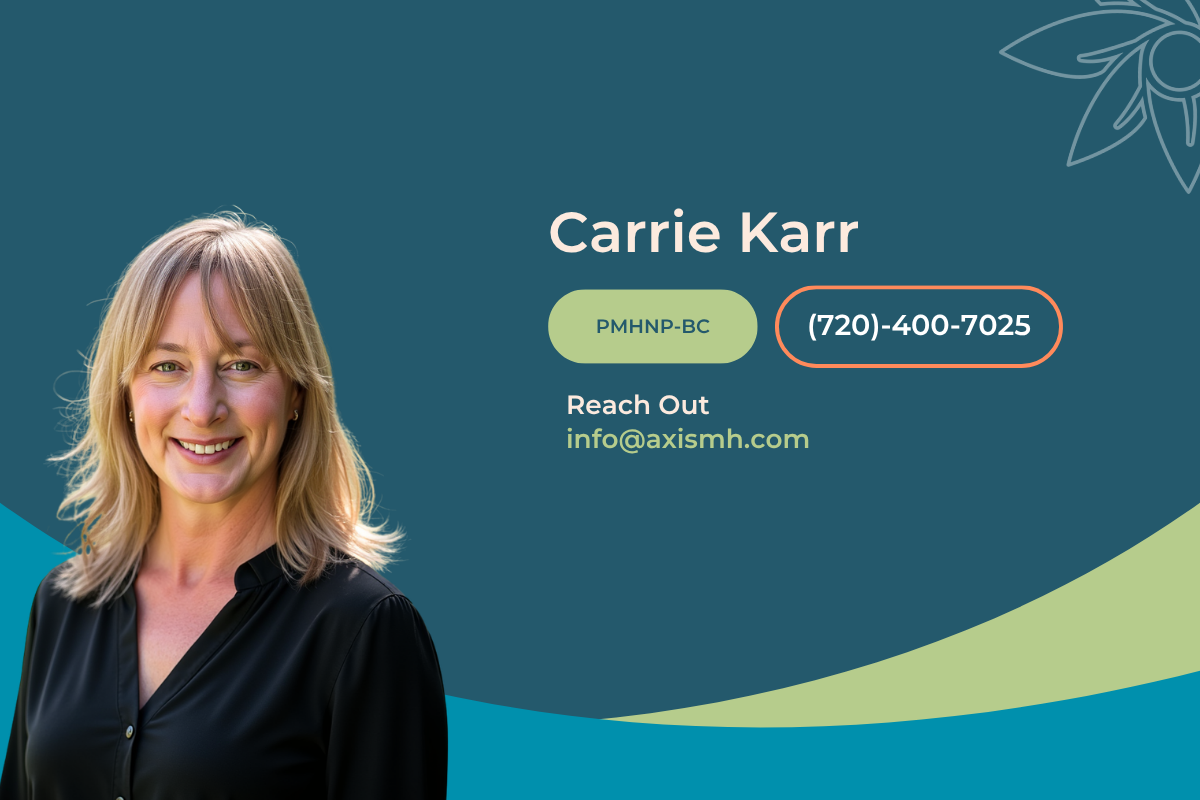
Most people searching for psychiatric help in Denver are not looking for more prescriptions. They are looking for someone who will actually listen, connect the dots between what is happening in their body and their mind, and help them build a treatment plan that accounts for who they actually are.
That description fits Carrie Karr, PMHNP-BC, a board-certified Psychiatric Mental Health Nurse Practitioner at Axis Integrated Mental Health. What makes her approach stand out is not a single specialty but a rare combination of clinical depth, fifteen years of on-the-ground psychiatric experience, and a philosophy of care that most providers simply do not practice.
The Problem Most Psychiatric Patients Know Too Well
You have probably heard the phrase “medication management” so often it has lost its meaning. In practice, for too many patients, it means a 15-minute appointment, a quick symptom check, and a prescription renewal.
That is not enough for patients dealing with treatment-resistant depression. It is not enough for adults managing co-occurring psychiatric and substance use conditions. It is not enough for older adults whose physical health and psychiatric health are deeply intertwined. And it is not enough for anyone who has been taking supplements or herbs alongside their medications and whose provider does not know, or has not asked.
The gap between what psychiatric medication management can be and what patients often experience is one of the defining problems in mental health care today. In Colorado, that gap is especially visible. The state consistently ranks among the worst in the country for access to psychiatric providers relative to need. When patients do get an appointment, they often feel rushed through a system that treats symptoms in isolation.
Carrie’s patients describe a different kind of appointment. Not because she has unlimited time, but because she asks different questions.
How Carrie Karr’s Approach Is Different
Carrie came to psychiatric prescribing by an unusual route. Before earning her Master of Science in Nursing at Walden University and becoming a PMHNP, she spent over a decade inside hospital psychiatric units as a behavioral health RN and, eventually, as a clinical manager overseeing more than 50 staff members across geriatric psychiatry, adult psychiatry, ECT, and TMS units at AdventHealth Porter in Denver.
That experience gave her something most outpatient psychiatric providers do not have: she has seen what crisis looks like, what recovery looks like, and what happens when patients are discharged from inpatient care into an outpatient world that is not ready for them. She uses that knowledge to meet patients where they are rather than where the chart suggests they should be.
Her clinical approach is built around a few specific commitments.
Evidence-based care that accounts for the whole person. Every treatment plan Carrie builds starts with DSM-based evaluation and evidence-based medication selection. But it does not stop there. Carrie holds advanced training in herbal therapeutics from the Rocky Mountain Center for Botanical Studies in Boulder, which included supervised clinical practice and focused coursework in pharmaceutical-herb interactions, nutrition, and integrative approaches. This is not a credential most psychiatric nurse practitioners hold, and it changes the clinical conversation in meaningful ways. When a patient arrives taking St. John’s Wort or ashwagandha alongside a psychiatric medication, Carrie already knows why that matters and what to do about it.
Dual diagnosis expertise that does not separate what cannot be separated. At Jefferson Center for Mental Health, Carrie served as the lead provider at a community walk-in substance use clinic, one of the most demanding and underserved corners of the mental health system. She prescribed medication-assisted treatment, conducted ASAM assessments, and worked in close collaboration with therapists and case managers to address the social determinants of health that make recovery possible or impossible. She brings that integrated, non-judgmental framework to every patient with co-occurring conditions.
Deep familiarity with advanced treatment modalities. Not every patient responds to first-line antidepressants, and Carrie is equipped to evaluate and help coordinate next-step options. She played a direct role in launching AdventHealth’s TMS program years before joining Axis, developing clinical policies, training staff, and building the workflows that made the program run. She understands Transcranial Magnetic Stimulation from the inside out. At Axis, she can work with patients for whom ketamine therapy, Spravato (esketamine nasal spray), or Deep TMS may be appropriate next steps, and she can do so as a collaborating team member rather than a gatekeeper.
Who Is a Good Fit for Carrie’s Caseload?
Carrie works best with adults who are ready to be partners in their care. That might mean:
Patients who have tried antidepressants and found partial relief, no relief, or side effects that made continuing difficult. Carrie is experienced with complex cases and is comfortable discussing what other options exist, including when to consider referral within Axis for advanced interventions.
Adults managing both a psychiatric diagnosis and a substance use condition. This population is frequently undertreated because providers either lack comfort with dual diagnosis or do not have time to address both dimensions. Carrie has spent significant clinical time in exactly this space.
Older adults whose mental health and physical health feel tangled together. Carrie holds a Gerontological Nursing Board Certification alongside her PMHNP-BC, a combination that gives her a clinical vocabulary few other providers have when working with aging patients and their families.
Patients who use supplements or take an integrative approach to their health and want a prescriber who will engage with that rather than dismiss it.
People who have had discouraging experiences with the mental health system and are looking for a provider who will listen first.
What Brought Carrie to This Work
Carrie has been in psychiatric care settings since 2010, first as a new nurse at the Colorado Mental Health Institute at Fort Logan, then across more than a decade of clinical and leadership work at AdventHealth Porter. She did not move from nursing into prescribing because she wanted to leave bedside care. She moved because she wanted to do more.
The patients who have stayed with her longest in memory are the ones who arrived with complicated histories, where the path forward was not obvious. She became a nurse practitioner to be part of that problem-solving process in a different way, to hold the clinical authority to build and adjust treatment plans while staying connected to what she learned as a nurse: that patients are people first, that families matter, and that care plans that do not account for how someone actually lives do not work.
Her community involvement tells a similar story. She volunteered on a global health medical mission to Peru, providing care in Amazon villages. She served in emergency medical services at Burning Man two years running. She has been a member of the American Holistic Nurses Association since 2010. These are not resume decorations. They reflect someone who chose a big, complicated view of what health means.
What to Expect When You Work with Carrie
Your first appointment with Carrie is an evaluation. She will ask about your current symptoms, your history, what treatments you have tried before, and what is working and what is not. She will also ask about your physical health, what you are taking beyond prescribed medications, and what your life actually looks like.
From that evaluation, she will work with you to develop a care plan. Depending on your situation, that might mean starting or adjusting medication, coordinating with a therapist or other providers, discussing whether an advanced intervention like Spravato or Deep TMS deserves consideration, or simply building a clear picture of your care over time.
Carrie sees patients both in person at Axis’s Denver Tech Center location and via telehealth. She collaborates closely with the full Axis team, including therapists and specialists in advanced treatment modalities, so care does not have to stop at the edge of one provider’s scope. Axis accepts most major insurance plans.
Next Steps
If you have been searching for psychiatric help in Denver or the Denver Tech Center area, or if you have been trying to figure out whether the medication management you are receiving is actually working for you, Carrie Karr is worth a conversation.
Axis Integrated Mental Health’s Denver Tech Center clinic serves patients across the metro at locations in Denver, Aurora, Boulder, Westminster, and Louisville. Carrie is currently accepting new patients.
Book your appointment at axismh.com/book-online or call 720.400.7025. You do not have to keep working around a system that is not working for you. There is another option.