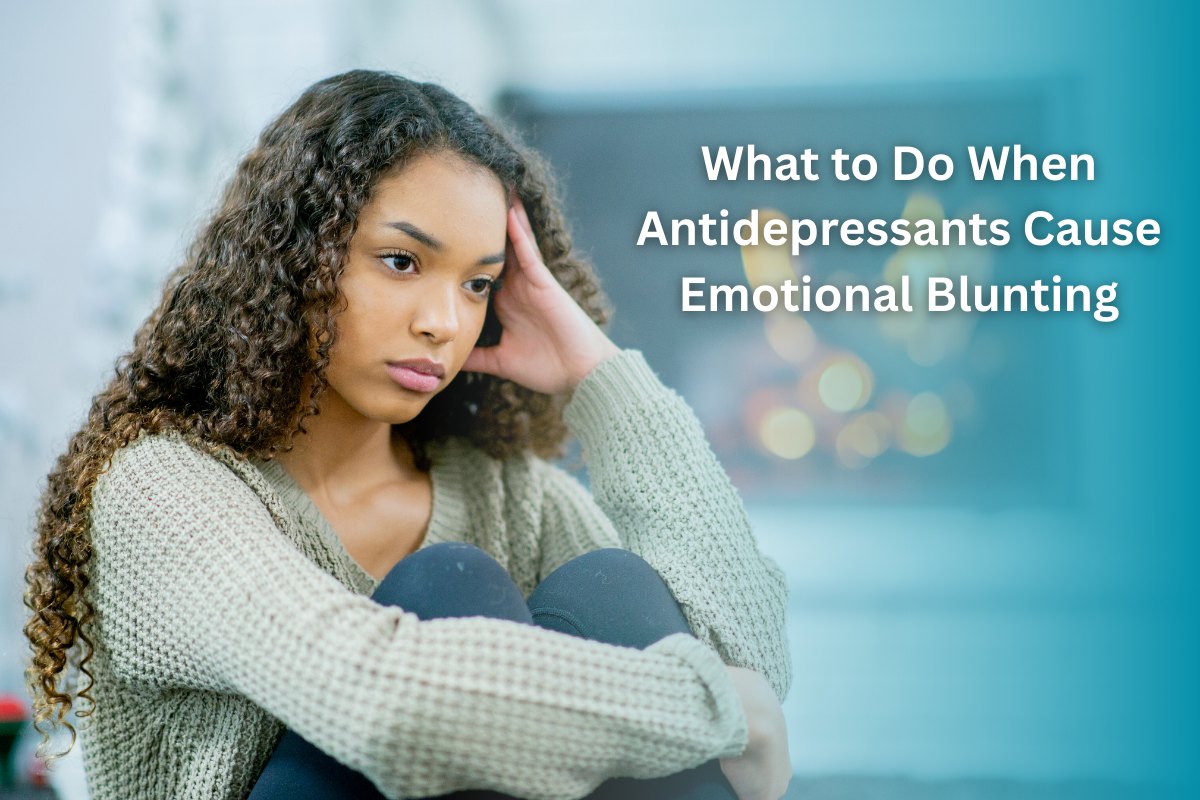
You started taking antidepressants to feel better. The crushing sadness lifted. The dark thoughts quieted. But something else changed too. You don’t cry during sad movies anymore. You don’t laugh as hard at jokes. Your partner says “I love you,” and you feel… nothing. Not sad. Not happy. Just flat.
This is called emotional blunting or anhedonia, and you’re not imagining it. You’re not broken. And you’re definitely not alone.
Research from Cambridge University found that 40%-60% of people taking antidepressants experience some form of emotional blunting. Understanding why this happens, and what you can do about it, starts with understanding how antidepressants work in your brain.
Why Antidepressants Stop Sadness but Also Mute Joy
Most antidepressants prescribed today are SSRIs (selective serotonin reuptake inhibitors). Think of medications like Prozac, Zoloft, Lexapro, or Celexa. These medications work by increasing serotonin levels in your brain.
Serotonin is often called the “feel-good” chemical. When you have major depressive disorder (MDD), your brain often has lower levels of serotonin. SSRIs help by blocking the reabsorption of serotonin, leaving more of it available in your brain.
Here’s where things get tricky. Serotonin doesn’t just affect sadness. It affects all emotions. When SSRIs flood your brain with extra serotonin, they can dampen the entire emotional spectrum. It’s like turning down the volume on a radio. You don’t just reduce the static, you also quiet the music.
Scientists have discovered that SSRIs specifically affect how your brain processes reinforcement learning. That’s the fancy term for how you learn from rewards and positive experiences. When this system gets dulled, everyday joys like a beautiful sunset, your child’s laughter, a favorite song don’t register as strongly.
Your depression medication is doing its job of reducing painful emotions. But it’s doing that job a little too well, reducing all emotions in the process.
Want to know how much switching to a different depression treatment will cost?
Deep TMS and Spravato can treat depression without emotional blunting. We now offer a free TMS Cost Calculator or Spravato Cost Calculator if you want a rough estimate of your out-of-pocket cost for alternative depression treatments. If you still have questions about your specific insurance benefits, you can book a free financial consultation with one of our team members who can check your coverage and walk you through your insurance plan.
At your appointment, we’ll tell you:
- What your insurance plan requires to cover treatment
- Your estimated out-of-pocket cost
- What you can expect from TMS treatment including time commitments, when you might to start feeling better, and other options.
We believe that mental health is more than meds. Ask our team about how we can help you navigate insurance, payment plans, and how these treatments work, and more on your call.
Schedule a Free Treatment Cost Consultation
Book Now Before Slots Fill-out.
Recognizing the Signs of Emotional Blunting
Emotional blunting can sneak up on you. It’s not always obvious at first. You might notice:
In relationships: You care about your partner, but physical intimacy feels mechanical. You go through the motions but don’t feel connected. When they share exciting news, you respond with “that’s great” but don’t actually feel excited for them.
At work: Completing a big project doesn’t bring satisfaction. Getting praised by your boss feels empty. You’re not stressed about deadlines, but you’re also not motivated by accomplishments.
In daily life: Your favorite foods taste bland. Music sounds like background noise. Watching your favorite TV show feels like passing time rather than genuine enjoyment. You’re not crying anymore, but you’re not laughing either.
Creatively: If you’re an artist, writer, or creative person, you might feel like your work has lost its spark. You can still create, but the passion feels distant.
The most common description? Feeling like you’re watching your life through a window instead of living it directly.
According to a study published in the Journal of Affective Disorders, up to 60% of people taking SSRIs report reduced emotional responsiveness. This isn’t a rare side effect–it’s one of the most common experiences with these medications.
The Science Behind the Flatness: What’s Happening in Your Brain
When you take SSRIs, they increase serotonin activity at receptor sites throughout your brain. One key area affected is the prefrontal cortex, which helps regulate emotions and decision-making.
Research from Cambridge University used brain imaging to show exactly what happens. They found that SSRIs reduce activity in specific brain regions involved in processing emotional reinforcement. Essentially, the parts of your brain that help you feel rewarded by positive experiences become less active.
Think of it like this: Your brain has a reward system that lights up when good things happen. That system motivates you to seek out pleasurable experiences, connect with others, and engage with life. Depression meds can dim those lights.
This isn’t necessarily because you’re on the wrong medication or the wrong dose. It’s a known mechanism of how SSRIs work. They’re non-selective, meaning they affect serotonin throughout your entire brain, not just in the areas related to depression.
What You Can Do: Practical Steps Forward
If you’re experiencing emotional blunting, you have options. Here’s what mental health experts recommend:
Talk to your psychiatrist first. Never stop or change your medication without professional guidance. Suddenly stopping antidepressants can cause withdrawal symptoms and worsening depression. Your doctor needs to know what you’re experiencing so they can help you make informed decisions.
Consider adjusting your current medication. Sometimes a different SSRI causes less emotional blunting. Some people do better on SNRIs (like Effexor or Cymbalta) or other medication classes. Genetic testing may help identify which medications work best for your genes. Your psychiatrist might also lower your dose if you’ve been stable for a while. Lower doses sometimes maintain depression relief while reducing side effects.
Add talk therapy. Medication works on brain chemistry, but therapy teaches coping skills and helps you process emotions. Cognitive behavioral therapy (CBT) can be particularly helpful for recognizing and working through emotional numbness.
Evaluate your timing. Some people find that taking their medication at different times of day affects side effects. This won’t work for everyone, but it’s worth discussing with your doctor.
Look at the full picture. Are other factors contributing to emotional flatness? Poor sleep, lack of exercise, vitamin deficiencies, or thyroid problems can all affect emotional responsiveness. A comprehensive evaluation can identify other pieces of the puzzle.
When Standard Antidepressants Aren’t the Right Fit
For some people, the trade-off of emotional blunting isn’t worth the benefits. If you’ve tried multiple SSRIs and keep experiencing the same problem, or if emotional connection is critically important to your quality of life, it might be time to explore alternatives.
This is especially true if you’re dealing with treatment-resistant depression–meaning you’ve tried at least two different antidepressants without adequate relief or with intolerable side effects.
The good news? Depression treatment has evolved far beyond traditional antidepressants. Several evidence-based alternatives work through completely different mechanisms in your brain.
Alternative Depression Treatments That Work Differently
Ketamine therapy has emerged as one of the most promising treatments for depression, especially when SSRIs haven’t worked well. Unlike traditional antidepressants that affect serotonin, ketamine works on glutamate receptors and promotes new neural connections.
Most people notice improvement within hours or days rather than weeks. Studies show that approximately 65% of people with treatment-resistant depression respond positively to ketamine therapy. Many report that their emotions feel more natural and less blunted compared to SSRIs.
Ketamine therapy typically involves a series of infusions in a medical setting. At Axis Integrated Mental Health, we offer ketamine therapy at our Denver, Boulder, Aurora, and Westminster locations, combining medical treatment with therapeutic support for the best outcomes.
Deep TMS (transcranial magnetic stimulation) is another alternative that doesn’t involve medication at all. This FDA-approved treatment uses magnetic pulses to stimulate specific areas of your brain involved in mood regulation.
Because Deep TMS doesn’t flood your entire brain with neurotransmitters like SSRIs do, it tends to cause fewer side effects. People often maintain their full emotional range while experiencing significant depression relief. Treatment involves sitting in a comfortable chair while a helmet delivers magnetic pulses to your brain. Sessions last about 20 minutes, and most people need treatments several times per week for 4-6 weeks.
Spravato (esketamine) is a nasal spray version of ketamine that’s FDA-approved specifically for treatment-resistant depression. It works similarly to ketamine therapy but is administered differently and may be covered by insurance.
Combining approaches often works best. You might continue a lower dose of medication while adding therapy, Deep TMS, or ketamine. Or you might transition completely away from traditional antidepressants to alternative treatments. The right combination depends on your unique situation, symptoms, and goals.
Your Emotions Matter: Why Feeling Fully Is Important
Some people wonder if emotional blunting is really that big of a deal. After all, if you’re no longer depressed, isn’t that enough?
The answer is deeply personal. For some people, relief from depression is worth the trade-off of reduced emotional intensity. They’d rather feel calm and stable, even if that means less joy, than experience the crushing lows of depression.
But for many others, emotional connection is what makes life worth living. Feeling love for your children. Experiencing excitement about your future. Feeling moved by beauty or art. Connecting intimately with your partner. These aren’t luxuries–they’re fundamental parts of being human.
You deserve both relief from depression and the ability to feel joy. You shouldn’t have to choose between suffering and numbness. Modern mental health treatment offers options that can provide both.
How to Talk to Your Doctor About Emotional Blunting
Bringing up emotional blunting can feel awkward. You might worry your doctor will think you’re being ungrateful or difficult. You’re not. You’re advocating for your quality of life.
Here’s how to start the conversation:
Be specific about what you’re experiencing. Instead of saying “I feel weird,” try: “I’ve noticed I don’t feel excited about things that used to make me happy. I care about my family, but I don’t feel emotionally connected the way I used to.”
Use examples. “Before medication, I would cry during sad movies and laugh at funny ones. Now I feel emotionally flat watching both.”
Explain the impact. “This is affecting my relationship. My partner says I seem distant.”
Ask about options. “What alternatives could we consider? Are there different medications that might cause less emotional blunting? Would treatments like ketamine therapy or Deep TMS be appropriate for me?”
Be open to partnership. Your doctor wants you to feel better. Working together to find the right treatment is part of their job.
If your doctor dismisses your concerns or suggests you should just accept emotional blunting as the price of depression treatment, that’s a red flag. You deserve a provider who takes your quality of life seriously.
Finding the Right Mental Health Care in Colorado
At Axis Integrated Mental Health, we understand that effective depression treatment means more than just reducing symptoms. It means helping you live a full, emotionally connected life.
Our team specializes in alternative depression treatments for people who haven’t found success with traditional approaches or who are experiencing side effects like emotional blunting. We offer comprehensive evaluations to determine which treatments are right for your specific situation.
Whether you’re in Denver, Boulder, Aurora, or Westminster, our Colorado-based clinics provide access to cutting-edge treatments including:
- Ketamine therapy (Spravato™) for rapid relief
- Deep TMS for medication-free treatment and durability
- Psychiatric medication management with careful attention to side effects
- Therapy to support your healing journey
- Insurance prior authorizations all done for you
We’ve helped over 3,000 Coloradans find relief from depression while maintaining their emotional connection to life. Our integrated approach combines medical treatment with therapeutic support, ensuring you get comprehensive care that addresses all aspects of your mental health.
You Deserve to Feel Everything
Depression already took so much from you. It stole your energy, your hope, your ability to see a future. Your antidepressants helped bring some of that back. But you shouldn’t have to trade feeling devastated for feeling nothing.
Emotional blunting is a real side effect with real impacts on your life. Recognizing it and addressing it isn’t complaining–it’s taking your mental health seriously.
The right treatment exists. It might be a different medication. It might be an alternative approach like ketamine therapy or Deep TMS. It might be a combination that’s uniquely yours.
What matters is that you don’t settle for a life where you’re just going through the motions. You deserve to feel joy when good things happen. You deserve to feel connected to the people you love. You deserve to feel moved by beauty and excited about your future.
That’s not too much to ask. That’s what effective mental health treatment should provide.
If you’re experiencing emotional blunting from your antidepressants, reach out to a mental health provider who specializes in treatment-resistant depression and alternative approaches. Ask questions. Explore options. Advocate for yourself.
Your emotions aren’t a side effect you should tolerate. They’re an essential part of being human – and you deserve to feel them fully. Our patients have found that they finally feel like the real versions of themselves once they have tried treatments like TMS and Spravato. We know that you can too.
Frequently Asked Questions About Emotional Blunting
What is emotional blunting from antidepressants?
Emotional blunting is a common side effect where antidepressants reduce your ability to feel emotions intensely. You might notice you don’t feel as sad, but you also don’t feel as happy, excited, or emotionally connected to others. Research shows 40-60% of people taking SSRIs experience some degree of emotional blunting. This happens because medications like Prozac, Zoloft, and Lexapro increase serotonin throughout your entire brain, affecting all emotions rather than just negative ones. If you’re experiencing emotional flatness, talk to your psychiatrist about adjusting your treatment. Learn more about medication management options at Axis Integrated Mental Health.
How long does emotional blunting last on antidepressants?
Emotional blunting typically continues as long as you’re taking the medication that’s causing it. For some people, the effect lessens after several months as their body adjusts, but for many others it persists throughout treatment. The good news is that emotional blunting usually resolves within weeks of stopping or changing your antidepressant, though you should never stop medication without medical supervision. If you’ve been experiencing emotional numbness for more than a few months, it’s unlikely to resolve on its own. Consider discussing alternative treatments like ketamine therapy or Deep TMS with your mental health provider.
Can I reduce emotional blunting without stopping my antidepressant?
Yes, several strategies can help reduce emotional blunting while staying on your antidepressant. Your psychiatrist might lower your dose, switch you to a different SSRI or medication class that causes less blunting, or add therapy to help you reconnect with your emotions. Some people find that changing when they take their medication (morning versus evening) affects side effects. Adding regular exercise, maintaining good sleep, and addressing other health factors like vitamin deficiencies can also help. If these adjustments don’t work, alternative depression treatments like Deep TMS and Spravato work through different brain mechanisms and typically don’t cause emotional blunting. Explore comprehensive depression treatment options in Colorado.
What depression treatments don’t cause emotional blunting?
Several effective depression treatments work differently than SSRIs and typically don’t cause emotional blunting. Ketamine therapy acts on glutamate receptors instead of serotonin, with approximately 70% of people with treatment-resistant depression responding positively and most reporting more natural emotional range. Deep TMS uses magnetic pulses to stimulate specific brain areas without flooding your system with neurotransmitters and don’t involve medications. Some newer antidepressants like bupropion (Wellbutrin) work on different neurotransmitter systems and may cause less emotional numbing. At Axis Integrated Mental Health locations in Denver, Boulder, Aurora, and Westminster, we specialize in these alternative approaches.
How do I know if my emotional flatness is from antidepressants or depression itself?
This can be tricky since both depression and antidepressant side effects can cause emotional numbness, but there are key differences. If your emotional blunting started or worsened after beginning an antidepressant or increasing your dose, it’s likely medication-related. Depression-related numbness usually comes with other symptoms like lack of energy, hopelessness, and negative thoughts, while medication-related blunting often happens even when you feel mentally better overall. People with medication-induced emotional blunting often say they feel “flat” or “disconnected” rather than sad or hopeless. The most reliable way to know is working with a psychiatrist who can evaluate your full symptom picture and potentially adjust your treatment. Schedule a comprehensive evaluation at Axis Integrated Mental Health to get personalized answers.
What Will Depression Treatment Actually Cost You?
Our free calculator gives you an estimate in under 60 seconds, based on our years of experience submitting prior authorizations. No calls required.
Spravato Therapy Cost Calculator
Estimate your out-of-pocket cost in under 60 seconds
Deep TMS Cost Calculator
Estimate your out-of-pocket cost in under 60 seconds
This is a general estimate only. Your actual cost may differ. Axis verifies your exact benefits before treatment begins. No insurance data is stored.