
When Antidepressants Are Not Enough
You have done everything right. You saw your doctor. You tried medication. Maybe you even tried two or three different ones. Some helped a little. Some did not. And you are still waking up most mornings under a weight you cannot explain to the people who love you.
This is not failure. It is actually a well-documented clinical reality. Research from the National Institute of Mental Health found that roughly one in three people with major depressive disorder do not achieve full remission with their first antidepressant. Many cycle through multiple medications across years before finding meaningful relief, and some never do through medication alone.
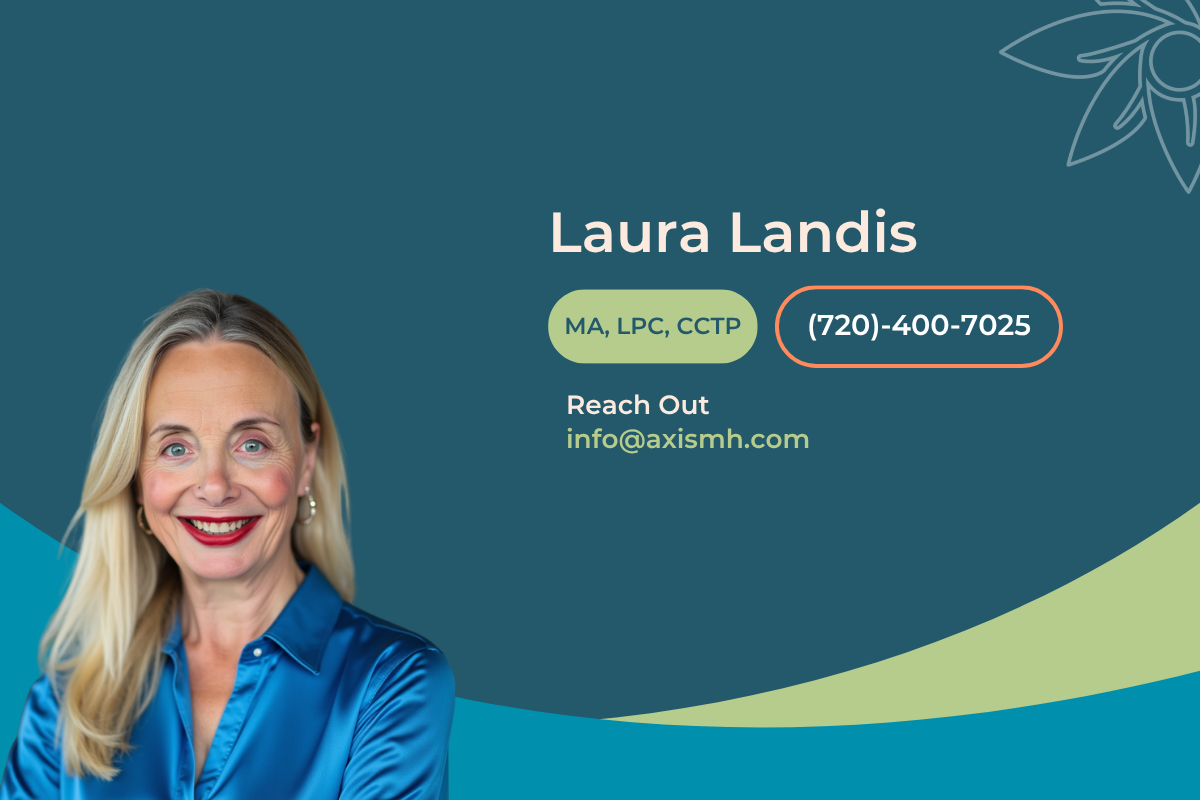
What these people often need is not more medication. They need a therapist who understands what to do when the standard tools are not working. That is exactly what Laura Landis, MA, LPC, CCTP brings to her clients at Axis Integrated Mental Health in Louisville and Boulder, Colorado.
Laura’s Approach: Why Treating Depression Requires Working with the Whole Nervous System
Laura does not treat a diagnosis. She treats a person.
After more than 35 years in clinical practice across emergency psychiatry, partial hospitalization, community mental health, and outpatient therapy, Laura has developed a layered, integrated approach to treating depression that most therapists simply do not offer.
Her work begins with a foundational question: where is this person’s nervous system right now? Using Polyvagal Theory, she assesses whether a client’s depression is rooted in a chronic shutdown or collapse state, a hypervigilant survival response, or a more relational wound that has calcified over time. This matters because the right intervention depends entirely on the answer.
From there, she draws on a range of evidence-based and emerging approaches to match the treatment to the person:
- EMDR therapy (Eye Movement Desensitization and Reprocessing) to process trauma memories that may be sustaining depressive symptoms
- The Flash Technique, an EMDR-adjacent method that allows trauma reprocessing with significantly less distress than traditional approaches
- Internal Family Systems (IFS) therapy to work with the self-critical internal voices that drive depression inward
- Felt-Sense Focusing and somatic processing to help the body release what the mind has been carrying
- Ketamine-Assisted Psychotherapy for clients with treatment-resistant depression, where Laura’s certification allows her to provide the therapeutic framework that makes ketamine therapy most effective
The Flash Technique: One Thing Competitors Miss
Most therapists who use EMDR do not use the Flash Technique. Laura does. Developed by Dr. Philip Manfield as a gentler entry point into trauma reprocessing, the Flash Technique allows clients to begin processing highly distressing memories without having to fully re-experience them. For people with depression that has trauma at its root, this is a meaningful clinical advantage. It makes treatment accessible to clients who might otherwise find traditional trauma therapy too overwhelming to sustain.
Laura first trained in EMDR in 1999 and completed a refresher after returning to practice in 2023. She has since integrated the Flash Technique into her regular clinical toolkit, making her one of a small number of Colorado therapists offering both.
Who Benefits Most from Working with Laura
Laura works best with adults who are ready to go deeper than their symptoms. Her clients often include:
- People with depression that has not fully responded to medication, including those exploring or already receiving ketamine therapy through Axis
- Adults carrying complex or developmental trauma who have struggled to make progress in traditional talk therapy
- LGBTQ+ individuals, particularly transgender and nonbinary people, who want a therapist with genuine lived experience of gender transition and identity
- Adults in recovery from substance use who also carry depression or unresolved trauma
- People experiencing grief, major life transitions, or what Laura calls the costs and consequences of finally choosing yourself
She serves clients in-person at Axis Integrated Mental Health in Louisville, Colorado, and by telehealth throughout the state. Boulder-area residents can access her via telehealth or the Axis Boulder location.
Laura’s Story: Why This Work Is Personal
Laura did not start her career in mental health. She spent nearly a decade as a pharmaceutical research chemist before deciding, at 31, to sell her home in Vermont, pack up her three young children, and start over at graduate school in New Hampshire. It was a bold move driven by a simple clarity: she was more interested in people than in molecules.
What followed was three and a half decades of clinical work that took her from small New Hampshire community mental health offices to emergency psychiatric units in Albuquerque, from EAP counseling for bank robbery survivors to founding and directing her own agency serving adults with developmental disabilities. In 2015, she sold the agency, bought a 34-foot sloop, and spent eight years sailing mostly alone between Nova Scotia and the Florida Keys.
She came back to clinical work in 2023. Not because she had to, but because she wanted to be of service.
Laura’s personal story also includes her own experience of gender transition in the late 1990s. She speaks about this openly, not as the most defining thing about her, but as context for the kind of change she knows is possible. She has described it as making a difficult crossing to a far shore and finding a life that fits. For clients facing their own version of an impossible crossing, that matters.
She is also in active recovery, which shapes the way she meets clients who carry both depression and substance use histories. She does not bring judgment to that room. She brings understanding.
What to Expect When You Work with Laura
Your first session with Laura is primarily a conversation. She wants to understand what you have already tried, what has helped, what has not, and what you are hoping for. She does not rush toward a treatment plan. She listens first.
From there, most clients work with Laura on a weekly basis, with session frequency adjusted as needed. Depending on your history and goals, your work together may involve a combination of modalities. If you are also receiving ketamine treatment through Axis, Laura can provide the therapy component that dramatically improves outcomes.
Treatment timelines vary. Some clients see meaningful shifts in a few months. Others do deeper work across a year or more. Laura is honest about this. She does not promise quick fixes. She offers sustained, skilled attention to the whole person as well as access to the most cutting edge treatments for depression that can be combined with therapy for the highest chance of remission.
Axis Integrated Mental Health accepts most major insurance plans. Their intake team verifies coverage before your first appointment so there are no surprises. Telehealth is available throughout Colorado.
Ready to Start? Book a Free Consultation
Laura Landis is currently accepting new clients at Axis Integrated Mental Health in Louisville, Colorado. To learn more or schedule your first appointment, visit axismh.com or call the Axis intake line.
If you have been trying to treat depression for a while without getting the results you need, you are not out of options. You may just need someone who understands what to do next.