
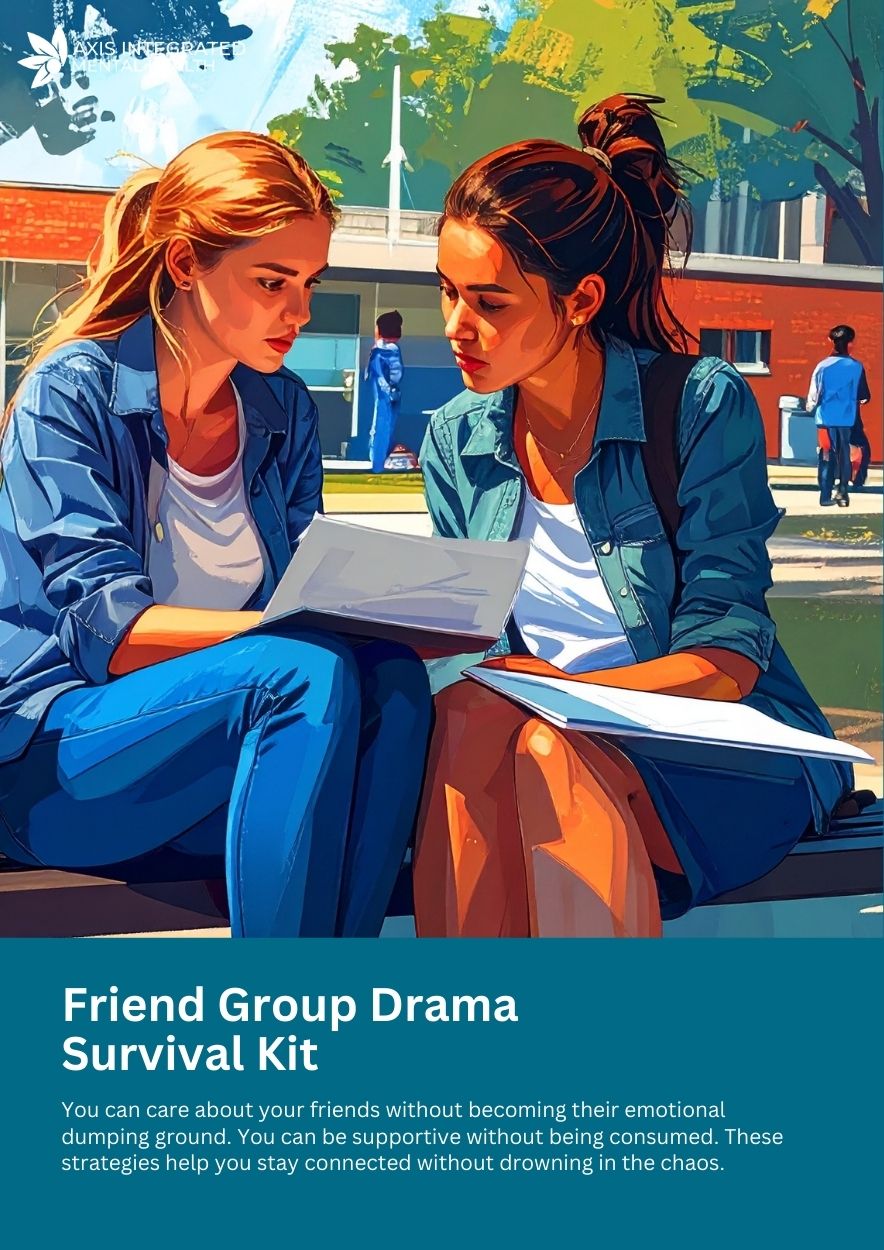
Friend group drama is an inevitable part of teenage life. But for many teens, it can feel like an emotional tornado that threatens to uproot their entire world.
One day your teenager comes home devastated because their best friend is ignoring them; the next day they’re stressed about being caught between two friends who are fighting; the following week brings anxiety about group plans they weren’t included in.
As a parent, watching your teen navigate these social minefields can be exhausting and heartbreaking. You want to protect them from pain, but you also know they need to learn how to handle relationships independently.
The key is helping them develop strategies to stay connected with friends without becoming emotionally consumed by every social conflict.
This blog is all about building your teen’s capacity to engage with friendship challenges in healthy ways while protecting their mental health and maintaining perspective.
Understanding Why Friend Group Drama Hits So Hard for Teens
The Neuroscience of Teenage Friendship
During adolescence, peer relationships become neurologically prioritized in ways they weren’t during childhood.
The teenage brain’s reward system is particularly sensitive to social acceptance and rejection.
Brain imaging studies show that social rejection activates the same neural pathways as physical pain, meaning that being excluded from a friend group literally hurts.
Additionally, the adolescent brain’s still-developing prefrontal cortex means teens have difficulty with:
- Emotional regulation during conflict
- Perspective-taking during heated moments
- Predicting long-term consequences of social decisions
- Distinguishing between temporary and permanent relationship changes
Why Drama Feels All-Consuming
Identity Formation: Teenagers are actively figuring out who they are, and peer relationships serve as mirrors for self-discovery. When friendships are unstable, it can feel like their entire identity is threatened.
Social Status Awareness: Teens are acutely aware of social hierarchies and their position within them. Friend group drama often involves questions of status, inclusion, and belonging that feel existentially important.
Limited Relationship Experience: Adults can draw on decades of relationship experience to put current conflicts in perspective. Teens lack this context, making each friendship crisis feel uniquely devastating.
24/7 Social Connectivity: Unlike previous generations, today’s teens can’t escape friend drama by going home. Social media and group chats mean conflicts follow them everywhere.
The 5 Drama Consumption Quota Strategies
-
The “Sip, Don’t Chug” Strategy
When someone starts unloading drama like a broken soda can, teach your teen to ask themselves: “Is this my problem, or am I just being pulled in?” If it’s not their conflict, they can care without carrying it all.
How It Works:
- Listen supportively for a few minutes
- Avoid giving advice unless specifically asked
- Set internal time limits for drama discussions
- Practice phrases like “That sounds really hard” without taking on emotional responsibility
Teaching Your Teen This Strategy: “You can be a good friend without becoming everyone’s therapist. Sometimes the most helpful thing is listening without trying to fix everything.”
Red Flags That They’re “Chugging” Drama:
- Losing sleep over friends’ conflicts that don’t involve them
- Feeling responsible for solving other people’s relationship problems
- Experiencing anxiety about situations they can’t control
- Becoming the go-between for fighting friends
-
The “3-Text Max” Rule
If the group chat is spiraling into drama, your teen limits themselves to 3 drama-related replies before muting the thread. This prevents them from getting sucked into circular arguments or feeling obligated to respond to every development.
Implementation Steps:
- Text 1: Acknowledge the situation (“That sounds frustrating”)
- Text 2: Offer brief support (“Hope you guys can work it out”)
- Text 3: Set boundary (“Going to step back and let you two figure this out”)
- Mute the conversation and check back later when emotions have cooled
Why This Works:
- Prevents impulsive responses that might escalate conflict
- Reduces the feeling of being trapped in ongoing drama
- Maintains friendships without enabling toxic communication patterns
- Teaches healthy boundary-setting skills
Sample Scripts for Your Teen:
- “I care about both of you, but I’m not comfortable being in the middle”
- “This seems like something you two should work out directly”
- “I’m going to take a break from the group chat for a bit”
-
The “Ice Cube Timeout” Technique
When your teen feels heated or anxious about drama, they do something physically grounding before responding. This interrupts the emotional escalation and prevents regrettable reactions.
Physical Grounding Options:
- Wash face with cold water
- Take a 5-minute walk outside
- Do 10 jumping jacks or push-ups
- Hold an ice cube until it melts
- Practice deep breathing for 2 minutes
The Science Behind It: Physical grounding techniques activate the parasympathetic nervous system, which calms the fight-or-flight response. This gives the prefrontal cortex time to engage before emotions take over completely.
Teaching Your Teen: “When you feel that surge of anger or panic about friend drama, your body is trying to protect you. But sometimes that protection makes things worse. Taking a few minutes to calm your nervous system helps you respond from a clearer place.”
-
The “Spare Couch Friend” Plan
Your teen identifies a safe person outside their main friend group—a cousin, neighbor, someone from a different activity, or family friend. When group drama explodes, this person serves as their “spare couch”—someone they can emotionally crash with, no questions asked.
Characteristics of Good Spare Couch Friends:
- Not involved in the main friend group dynamics
- Good listener who doesn’t immediately give advice
- Available for low-key activities (walks, movies, crafts)
- Trustworthy and discrete about personal information
- Positive influence who doesn’t add to drama
How to Help Your Teen Develop These Relationships:
- Encourage participation in multiple activities/groups
- Support connections with family friends’ teens
- Facilitate opportunities for your teen to meet peers outside school
- Model having diverse friendships yourself
Sample Conversation: “Everyone needs people they can talk to when their main friend group is stressful. Who in your life feels like a safe person to vent to when things get complicated?”
-
The “Energy Budget” Approach
Each day, your teen gives themselves a mental “drama budget.” Only so much energy goes to school stress, friend conflicts, or emotional chaos. Once that budget is spent, they log off emotionally.
Creating a Daily Energy Budget:
Morning Energy Assessment (1-10 scale):
- How much energy do I have today?
- What are my priorities?
- How much drama energy can I afford to spend?
Drama Energy Allocation:
- High energy days: Can handle more friend conflicts and still function
- Medium energy days: Can listen supportively but not get deeply involved
- Low energy days: Need to protect energy and avoid drama discussions
End-of-Day Check-in:
- Did I overspend my drama energy today?
- What drained me most?
- How can I protect my energy better tomorrow?
Teaching Energy Budgeting: “Just like you budget money for different things, you can budget emotional energy. You only have so much to spend each day, and you get to choose how to use it.”
Helping Your Teen Set Healthy Friendship Boundaries
Recognizing Toxic Friend Group Dynamics
Help your teen identify patterns that consistently drain their energy or compromise their wellbeing:
Emotional Manipulation:
- Friends who threaten to end the friendship over minor disagreements
- Using guilt, shame, or silent treatment to control behavior
- Making your teen feel responsible for others’ emotions
Exclusion Tactics:
Deliberately leaving your teen out of plans, then discussing them publicly
Creating “inner circle” and “outer circle” hierarchies
Using inclusion/exclusion as punishment for perceived slights
Drama Creation:
- Friends who consistently create chaos or conflict
- Those who share private information to stir up problems
- People who seem to enjoy emotional turmoil
Teaching Boundary-Setting Skills
The “Broken Record” Technique: When friends pressure your teen to get involved in drama, they repeat the same boundary phrase calmly:
- “I don’t want to get in the middle of this”
- “That’s between you and [friend’s name]”
- “I care about you both, but I’m staying out of it”
The “Information Diet” Strategy: Your teen controls how much personal information they share and how much drama they consume:
- Share fewer personal details with drama-prone friends
- Avoid asking for updates on ongoing conflicts
- Change the subject when conversations become toxic
The “Gradual Fade” Method: For friendships that have become consistently unhealthy:
- Slowly reduce time spent together
- Become less available for drama discussions
- Invest more energy in healthier relationships
- Maintain politeness but create emotional distance
Supporting Your Teen Through Friend Group Changes
When Friendships Naturally Evolve
Sometimes friend groups change not because of dramatic conflicts but because people grow in different directions. Help your teen understand that this is normal and healthy.
Signs of Natural Friend Group Evolution:
- Different interests developing over time
- Friends moving or changing schools
- New activities creating new social connections
- Gradual drifting rather than explosive conflicts
Supporting Natural Transitions:
- Validate that losing friendships can be sad even when it’s healthy
- Encourage maintaining positive connections when possible
- Help them reflect on what they learned from past friendships
- Support exploration of new social opportunities
When Intervention May Be Necessary
If your teen is struggling with anxiety before or after school constantly, you may want to consult a provider and get them help.
While most friend drama resolves naturally, some situations require parental intervention:
Safety Concerns:
- Cyberbullying or harassment
- Threats of violence or self-harm
- Pressure to engage in dangerous behaviors
- Friends who encourage risky activities
Mental Health Impact:
- Your teen’s grades declining due to friend stress
- Persistent anxiety or depression related to social conflicts
- Loss of appetite or sleep disturbances lasting more than a week
- Complete social isolation or withdrawal
School Involvement Needed:
- Drama affecting classroom environment
- Conflicts involving multiple friend groups
- Situations where school counselors could mediate
- Harassment happening on school grounds
Building Resilience for Long-Term Friendship Success
Developing Emotional Intelligence
Help your teen build skills that will serve them in all future relationships:
Emotion Identification:
- Recognizing their own emotional states during conflict
- Understanding how their emotions affect their behavior
- Identifying others’ emotions without taking responsibility for them
Communication Skills:
- Expressing needs and boundaries clearly
- Listening without immediately trying to fix or judge
- Asking clarifying questions during conflicts
- Using “I” statements instead of accusations
Conflict Resolution:
- Understanding that some conflicts don’t need to be resolved immediately
- Learning when to apologize and when to stand firm
- Developing compromise skills
- Knowing when to agree to disagree
Teaching Self-Advocacy
In Friend Conflicts:
- How to speak up when feeling hurt or left out
- Ways to address problems directly instead of through others
- Strategies for maintaining friendships while protecting boundaries
In Group Dynamics:
- How to contribute to positive group energy
- Ways to redirect negative conversations
- Skills for including others who might be left out
Building a Diverse Social Network
Encourage your teen to cultivate friendships across different contexts:
Multiple Friend Groups:
- School friends, activity friends, neighborhood friends
- Online communities related to their interests
- Intergenerational relationships (mentors, family friends)
Benefits of Diverse Friendships:
- Reduced dependence on any one social group
- Different perspectives and support systems
- Opportunities to explore various aspects of their personality
- Built-in support when one group experiences conflict
Creating a Family Plan for Supporting Social Resilience
Daily Check-ins That Work
The “Social Weather Report”: Instead of asking “How was school?” try:
- “How was the friend energy today?”
- “Did any social situations drain your battery?”
- “What was the best and most challenging part of your social day?”
Timing Matters:
- Right after school when emotions are fresh
- During car rides when eye contact isn’t required
- While doing activities together (cooking, walking)
- Before bed when defenses are naturally lower
When Professional Support Helps
Therapy Can Be Beneficial When:
- Friend drama consistently impacts your teen’s mental health
- Your teen struggles to set boundaries or recognize toxic relationships
- Social anxiety prevents them from forming healthy friendships
- Family relationships are strained by constant friend drama
Psychiatry Can be Beneficial When:
Here are the key indicators that psychiatry may be appropriate for a teen with anxiety:
- Significant functional impairment – Symptoms interfere with daily activities like persistent school avoidance, social withdrawal, sleep disturbances, or unexplained physical symptoms such as frequent headaches or stomachaches.
- Duration and persistence – Anxiety symptoms have lasted several weeks without improvement despite family support and initial coping strategies.
-
- Severity of symptoms – Your teen expresses feelings of hopelessness, thoughts of self-harm, or shows signs that go beyond typical developmental stress.
- Professional assessment needed – A psychiatrist can provide comprehensive evaluation to distinguish between normal teenage stress and clinical anxiety disorders, offering evidence-based treatments including therapy and medication when necessary. Sometimes, anxiety can be a result of undiagnosed ADHD.
- Goal of treatment – Professional intervention helps teens develop healthy coping skills and regain their quality of life when other support systems haven’t provided adequate relief.
Insurance vs. Private Pay Considerations
Insurance-Covered Options:
- Often include both individual and group therapy options
- May require referrals or pre-authorization for ongoing treatment
- Typically focus on evidence-based treatments like CBT or DBT
- Will cover psychiatric med management but not advanced treatments like Spravato or Deep TMS
Private Pay Benefits:
- Greater flexibility in treatment approaches and session frequency
- Ability to choose therapists who specialize specifically in teen social issues
- More privacy regarding treatment records
- Access to cutting-edge treatments like Deep TMS
Friend group drama doesn’t have to consume your teenager’s life or dominate your family’s emotional energy.
By teaching practical strategies for managing social conflicts while maintaining healthy boundaries, you’re giving your teen lifelong skills for building and maintaining relationships.
Additional Resources
- How to Help Your Teen Navigate Social Anxiety at School?
- Which Factors Impact Your Teen’s Mental Health?
- Why Is Colorado’s Suicide Rate Among the Highest in the USA?
- TMS Treatment for Teenage Depression
At Axis Integrated Mental Health, we understand that teen social challenges often require professional support to develop healthy patterns.
Our experienced therapists work with teenagers and families to build communication skills, set appropriate boundaries, and create sustainable strategies for managing the social complexities of adolescence. Book online today to start building a foundation for effective anxiety control.
Frequently Asked Questions
How do I know if my teen’s friend group drama is normal or if it’s becoming a serious mental health concern?
Normal friend drama involves temporary conflicts that resolve within days or weeks and don’t significantly impact your teen’s daily functioning. Concerning signs include persistent anxiety or teenage depression lasting more than two weeks, declining academic performance, complete social isolation, physical symptoms like headaches or stomach issues, or any mention of self-harm. If friend drama consistently prevents your teen from sleeping, eating, or participating in activities they used to enjoy, consider professional support.
My teen constantly gets pulled into their friends’ conflicts and comes home emotionally exhausted. How can I help them set better boundaries?
Start by validating that being a caring friend is a positive trait while helping them understand the difference between supporting and fixing. Teach the “drama budget” concept: they only have so much emotional energy each day and get to choose how to spend it. Practice phrases for setting boundaries like “I care about you, but I can’t be in the middle of this.” Help them identify when they’re “sipping” drama (healthy support) versus “chugging” it (becoming overwhelmed).
Should I intervene when I see my teenager’s friend group engaging in toxic behaviors like exclusion or manipulation?
Direct intervention should be reserved for safety concerns or situations significantly impacting your teen’s mental health. Instead, focus on coaching your teen to recognize unhealthy patterns and develop strategies for protecting themselves. Ask questions like “How does it feel when they treat you that way?” or “What would a good friend do in this situation?” If the toxicity escalates to bullying, harassment, or is affecting your teen’s wellbeing severely, consider involving school counselors or mental health professionals.
My teen says they don’t want to talk about friend problems, but I can see they’re struggling. How do I support them without being intrusive?
Respect their stated boundary while creating opportunities for natural conversation. Try indirect approaches like sharing your own friendship experiences, asking specific questions during relaxed moments (“How’s your social battery these days?”), or offering practical support (“Want to invite someone over this weekend?”). Sometimes teens process better through activities than direct conversation. If the struggling continues without any communication, consider suggesting they talk to a school counselor or therapist.
When should we consider therapy specifically for friend group drama and social relationship issues?
Consider therapy when social conflicts consistently interfere with your teen’s daily life for more than a month, when they express hopelessness about friendships, when family relationships become strained by constant friend drama, or when your teen seems unable to recognize or leave unhealthy relationship patterns. Therapy can be particularly helpful for teens who struggle with boundary-setting, have difficulty reading social cues, or experience anxiety that prevents them from forming healthy friendships. Both individual and group therapy can provide valuable skills for navigating social relationships.