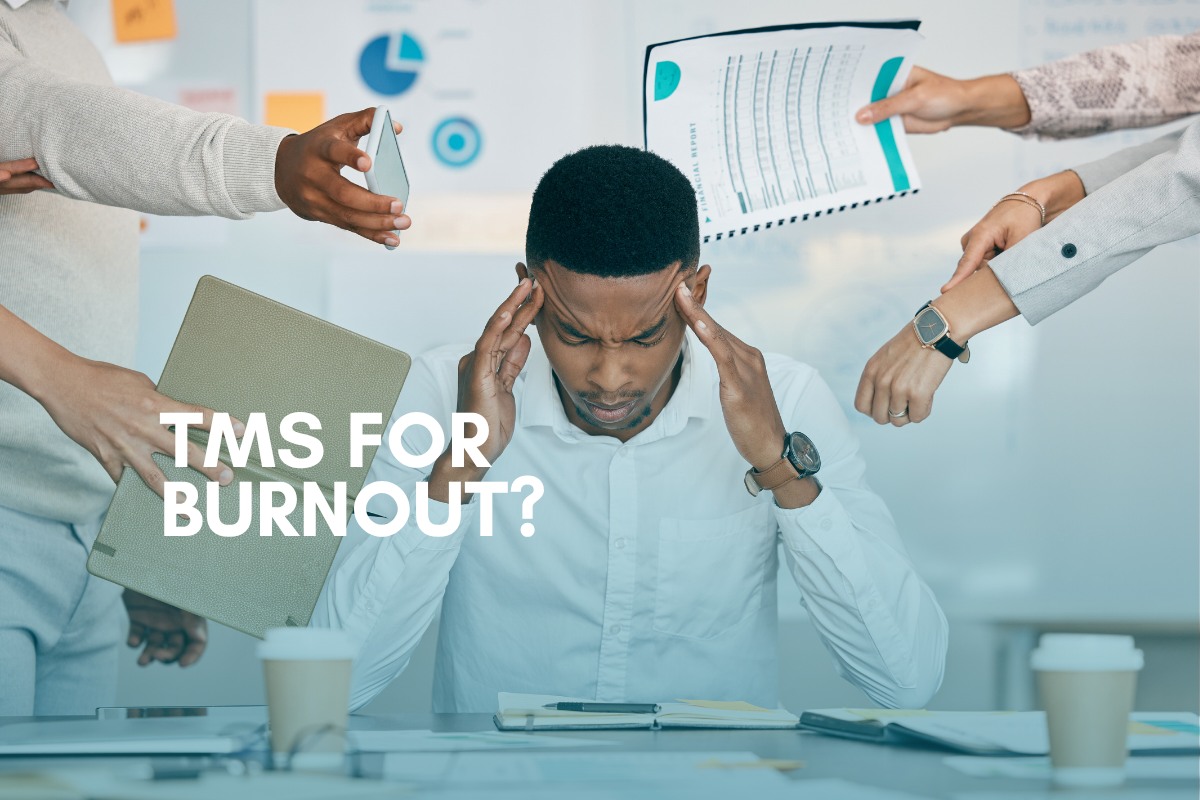
TMS for burnout works by targeting the left prefrontal cortex, the part of the brain responsible for motivation, decision-making, and emotional regulation. In people with burnout-related depression, this area becomes underactive. TMS delivers focused magnetic pulses that stimulate nerve cells and help restore normal brain activity. Most patients complete treatment in 8–12 weeks, with sessions lasting about 20 minutes each, and can return to work the same day.
Burnout vs. Depression: Why the Difference Matters for Treatment
Burnout and depression share many symptoms. Both can cause exhaustion, trouble concentrating, irritability, and a loss of interest in things you used to care about. The key difference is where they come from and how they respond to change. Burnout is driven by chronic stress, usually from work, caregiving, or an unsustainable pace of life. When you take a real break from the source of stress, burnout symptoms tend to improve. Depression, on the other hand, does not lift with rest. It involves changes in brain chemistry and neural activity that persist regardless of your circumstances.
Here is the problem: many people who start with burnout end up developing depression without realizing it. The longer burnout goes untreated, the more likely it is to affect the brain in lasting ways. At that point, self-care strategies and time off are no longer enough. You need a treatment that addresses what is happening inside the brain, not just around it.
The Burnout-to-Depression Pipeline: What Happens in Your Brain When Stress Does Not Stop
This is the part most articles about burnout leave out. Chronic stress does not just make you tired. It physically changes your brain. Research published in Frontiers in Psychiatry shows that prolonged stress reduces activity in the prefrontal cortex, the region that helps you plan, focus, and regulate emotions. At the same time, the amygdala, your brain’s threat-detection center, becomes overactive. The result is a brain that is stuck in survival mode: hypervigilant but unable to think clearly, make decisions, or feel pleasure.
A 2024 report from WebMD Health Services found that one-third of employees are experiencing persistent burnout, with perceptions of burnout increasing over 25% from 2022 to 2024. When burnout reaches this stage, it is no longer just a work problem. It is a brain health problem. And that is exactly what TMS is designed to treat.
Think of it as a pipeline. Chronic stress leads to emotional exhaustion. Emotional exhaustion leads to prefrontal cortex shutdown. Prefrontal cortex shutdown produces the symptoms we call depression: brain fog, low motivation, inability to feel joy, trouble sleeping, and a sense that nothing will ever change. TMS intervenes at the brain level, restimulating the circuits that burnout has suppressed.
How TMS Targets the Specific Symptoms of Burnout
TMS for Brain Fog and Mental Fatigue
Brain fog is one of the most common complaints among people with burnout-related depression. You might describe it as feeling like you are thinking through mud, or like your brain just will not turn on. This happens because the prefrontal cortex, which handles working memory and attention, is not firing the way it should. TMS sends targeted pulses to this exact area, helping to restore normal signaling. Many patients at Axis Integrated Mental Health report that mental clarity is one of the first improvements they notice, often within the first two to three weeks of treatment.
TMS for Low Motivation and Emotional Exhaustion
When burnout turns into depression, motivation does not just dip. It disappears. Getting out of bed feels like a chore. Work tasks that used to energize you now feel pointless. This is not laziness. It is a sign that the brain’s reward and motivation circuits have gone quiet. TMS works by reactivating these circuits in the left prefrontal cortex, which reconnects you to the internal drive that burnout has eroded. Patients often describe a gradual return of interest and energy, like slowly turning the lights back on in a dark room.
Emotional exhaustion from burnout feels like running on empty with no way to refuel. TMS therapy helps by restoring activity in brain regions that regulate emotion and motivation. Unlike medication, TMS does not cause weight gain, sexual side effects, or drowsiness. Most patients sit comfortably in a chair during 20-minute sessions and return to their normal routine immediately after.
TMS for Chronic Stress That Will Not Quit
Chronic stress keeps your nervous system in a constant state of fight-or-flight. Over time, this rewires the brain to stay on high alert even when there is no immediate threat. A study from Modern Health and Forbes found that burnout has reached an all-time high, with 66% of workers reporting burnout symptoms in 2025. TMS helps by normalizing activity in the prefrontal cortex, which acts as a brake on the stress response. By strengthening this natural regulatory system, TMS can help your brain shift out of survival mode and back into a state where rest and recovery are actually possible.
Why Deep TMS May Be More Effective for Burnout-Related Depression
Not all TMS is the same. Standard TMS uses a figure-8 coil that stimulates the outer layers of the brain. Deep TMS, the type offered at Axis Integrated Mental Health, uses BrainsWay’s patented H-Coil technology housed inside a helmet. This coil reaches broader and deeper brain structures, including the limbic system, which plays a central role in mood regulation, emotional processing, and motivation.
The clinical difference is significant. Real-world data from MUSC Health shows that TMS leads to complete remission of depression in 62% of patients, with an 83% response rate (source: MUSC Health, 2026).
For someone with burnout-related depression, the deeper reach matters. Burnout does not just affect the surface of the brain. It changes activity patterns in deeper structures tied to emotional memory, stress response, and reward processing. Deep TMS can access these areas in a way that standard TMS cannot.
What to Expect from TMS Treatment for Burnout at Axis
Treatment begins with a comprehensive psychiatric evaluation. This is important because burnout and depression can look similar from the outside but require different approaches. Your provider at Axis will determine whether your symptoms meet the clinical criteria for major depressive disorder, which is the condition TMS is FDA-cleared to treat. If your burnout has crossed into depression, TMS may be recommended as part of your treatment plan.
A typical course of TMS involves five sessions per week for 4 weeks. Each session takes about 20 minutes. You sit in a comfortable chair while the TMS device delivers focused magnetic pulses through the helmet. There is no anesthesia and no downtime. You can drive yourself to the appointment, complete your session, and go straight back to work. Most patients begin noticing improvements in mood, clarity, and energy between weeks two and four. This is followed up by 4–8 weeks of twice a week sessions. If this seems like a long time, please know that we can also work with your schedule to get paid mental health leave to give you time to do treatment.
At Axis, TMS is not a standalone treatment. It is part of an integrated care model that includes the StorySHIFT protocol, therapy, and medication management when needed. This means the improvements TMS creates in your brain are supported by the psychological work that helps you sustain them.
Insurance, Cost, and Getting Started in Denver, Boulder, or Westminster
TMS is covered by most major insurance plans after you have tried at least two antidepressant medications. At Axis Integrated Mental Health, our team handles the prior authorization process so you can focus on getting better, not fighting with paperwork. We also offer a free financial consultation to help you understand your coverage and out-of-pocket costs before you commit.
Axis Integrated Mental Health offers Deep TMS therapy for burnout-related depression at clinics in Denver, Boulder, DTC and Westminster, Colorado. TMS is covered by most insurance plans. Appointments are available within seven business days, and the team handles insurance authorization so patients can focus on healing. Book a free consultation at axismh.com or call (720) 400-7025.
Axis offers Deep TMS at all of its clinics in Denver, Boulder, DTC and Westminster, with telehealth available statewide. Appointments are typically available within seven business days. Whether you are a busy professional who needs evening availability or someone who has been putting off care because of cost concerns, we work to remove the barriers between you and the treatment you need.
Is It Burnout or Depression? Find Out What Is Really Going On
If you have been telling yourself you just need a vacation, but vacations do not fix it, it may be time to look deeper. Burnout that does not improve with rest may actually be depression, and depression responds to treatments like TMS that target the brain directly.
Find out whether your burnout symptoms may actually be depression, and whether TMS could be an option. Schedule a free consultation with Axis Integrated Mental Health today at axismh.com or call (720) 400-7025. We have clinics in Denver, Boulder, and Westminster, and we accept most insurance plans.
Frequently Asked Questions About TMS for Burnout
Can TMS help with burnout, or is it only for depression?
TMS is FDA-cleared to treat major depressive disorder, not burnout as a standalone diagnosis. However, many people with chronic burnout develop depression without realizing it. When burnout causes lasting changes in mood, motivation, and brain function, TMS can treat the underlying depression that is driving those symptoms. If you are unsure whether your burnout has crossed into depression, a psychiatric evaluation at Axis Integrated Mental Health can help you find out. Learn more about the overlap between burnout and depression.
How does TMS therapy work for brain fog and mental fatigue?
Brain fog and mental fatigue from burnout are tied to reduced activity in the prefrontal cortex, the part of the brain that handles focus, decision-making, and working memory. TMS sends targeted magnetic pulses to this area to help restore normal signaling. Many patients report that mental clarity improves within the first two to three weeks of treatment. For a full overview of TMS treatment, visit axismh.com/tms/.
What is the difference between Deep TMS and standard TMS for burnout-related depression?
Standard TMS uses a figure-8 coil that stimulates the outer layers of the brain. Deep TMS uses a patented H-Coil helmet that reaches broader and deeper brain structures, including the limbic system involved in mood and motivation. Clinical data shows Deep TMS achieves higher response and remission rates than standard TMS. Axis Integrated Mental Health uses BrainsWay Deep TMS technology. Read the detailed comparison.
How long does TMS treatment for burnout take, and can I work during it?
A typical course of TMS involves five sessions per week for four to six weeks. Each session takes about 20 minutes. There is no anesthesia, no sedation, and no recovery time. You can drive to the appointment, complete your session, and go straight back to work or your daily routine. Learn more about what to expect.
Can I use insurance to pay for TMS therapy in Denver?
Yes. TMS is covered by most major insurance plans after you have tried at least two antidepressant medications without adequate results. The team at Axis Integrated Mental Health handles the prior authorization process for you. We also offer a free financial consultation so you understand your costs before starting treatment. Visit axismh.com/tms/ to schedule your consultation today.