
If you know which cousin is vegetarian, which gift still needs wrapping, and what time the airport shuttle leaves, you already know the answer to this question. The holidays do not land on everyone equally. In our clinics, the weeks between Thanksgiving and New Year’s bring a wave of women who are less sad than depleted, and who often feel guilty for saying so.
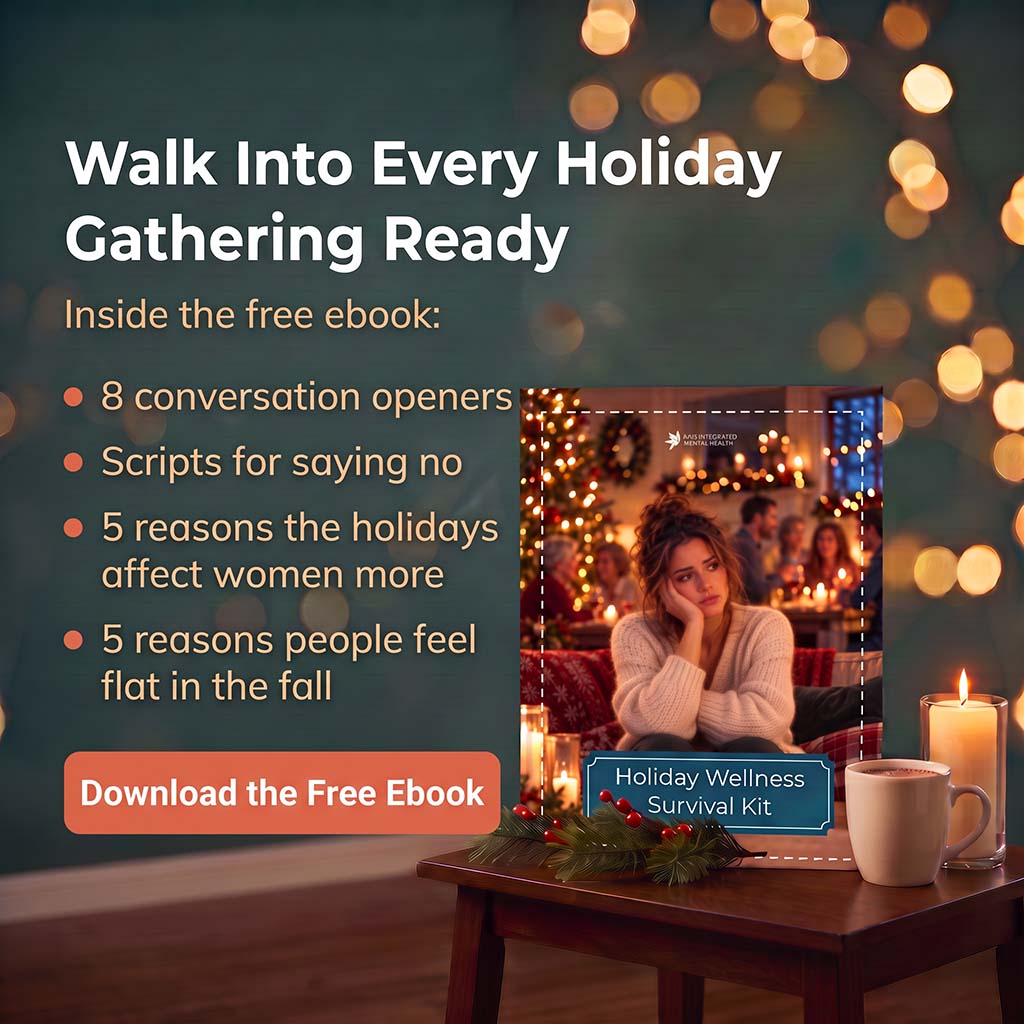
This section comes straight from our 2026 Holiday Wellness Survival Kit. It names five things that stack up for women this time of year, from the planning nobody sees to the hormone shifts that make December harder than it needs to be. Each one ends with a small, specific thing to try.
It is usually a mix of invisible labor, hormonal sensitivity, sleep disruption, social performance, and old emotional patterns getting reactivated all at once.
Only 27%: The share of women who say they can actually relax during the holidays.
41%: Adults who expected more holiday stress in 2025 than the year before, up from 28%.
1) The Cognitive Labor
For a lot of women, the holidays aren’t an event. They’re a full production. She’s the director, the caterer, the stage crew, and the only person who remembers Aunt Deb is gluten-free.
It’s the work of noticing what needs to happen, finding options, deciding, and following up. Women tend to do more of the noticing and the following up, and in one study of moms, this invisible work was linked to stress, burnout, and depression.
Try this: Give one job away completely. No checking in. Yes, even if the napkins don’t match.
2) The Holiday Travel Anxiety
She isn’t just catching a flight. She’s tracking snacks, chargers, medications, boarding times, the hotel, the ride, and the backup plan for the backup plan.
All that planning keeps your stress response switched on for days. It shows up as a tight jaw, snapping over small stuff, or a sudden urge to cancel the whole trip and move to a cabin.
Try this: Build one “nothing” hour into every travel day. No plans, no errands, no sightseeing.
3) The Hormonal Knob
For some women, the holidays land right on top of PMS, PMDD, perimenopause, or the months after having a baby. Suddenly criticism cuts deeper, crowds feel louder, and patience runs out faster than the good wrapping paper.
PMDD is not just a bad PMS week. It affects about 2% to 6% of women who menstruate, and many more have premenstrual symptoms that are rough but don’t meet full criteria. Hormone shifts can also make existing anxiety or depression feel worse, and especially if a woman has undiagnosed ADHD. During perimenopause, the risk of depression runs about 40% higher.
Try this: Track your mood every day for two cycles. A pattern isn’t drama. It’s data, and it’s the first thing a provider will ask about.
4) Sleep Inconsistency
Your brain without sleep is basically a Tamagotchi nobody fed. It still works, technically, but it’s beeping a lot. In one brain imaging study, a full night without sleep made the brain’s emotional center over 60% more reactive. Women are also more likely than men to have trouble falling asleep in the first place.
Try this: Protect your bedtime like it’s a Blockbuster return deadline. The late fees are real.
5) Overstimulation
The lights. The music. The crowds. The perfume counter. The small talk. The pressure to be “on” from 9 a.m. to midnight. Holiday stress isn’t only emotional. It can be sensory. You can love your family, feel grateful, and still feel completely flooded by too much input.
Try this: Plan your exit ramps ahead of time, like a short walk, a car break, or noise-canceling earbuds. Think of it as an AIM away message for real life: “BRB, recharging.”
None of these five are character flaws. They are load, and load can be redistributed, tracked, and planned around. If the hormonal piece sounds familiar, or if the flatness has lasted well past the last gathering, that is worth a conversation with a provider rather than another year of pushing through. Axis treats PMDD, perinatal, postpartum, and perimenopausal depression, and most of our care is covered by insurance.
This is one section of the full 2026 Holiday Wellness Survival Kit, which also covers grief, boundaries, breathwork, journal prompts, and a few things to do in Colorado that nobody has to organize. You can read the whole guide at axismh.com/holiday-wellness-survival-kit.