What Happens When Depression Doesn’t Respond to Medication? Meet Greenwood Village’s TMS and Spravato Specialist
You’ve tried two or three different antidepressants. Maybe four. Your psychiatrist keeps saying “let’s give it a few more weeks,” but it’s been months—sometimes years—and you’re still struggling to get out of bed, maintain focus at work, or feel anything beyond persistent numbness. You’re wondering if this is just how life will be.
This is the reality of treatment-resistant depression, and it’s far more common than most people realize. Approximately 30% of patients with major depressive disorder don’t achieve adequate response with first-line antidepressant medications. But here’s what matters: treatment-resistant depression doesn’t mean untreatable depression.
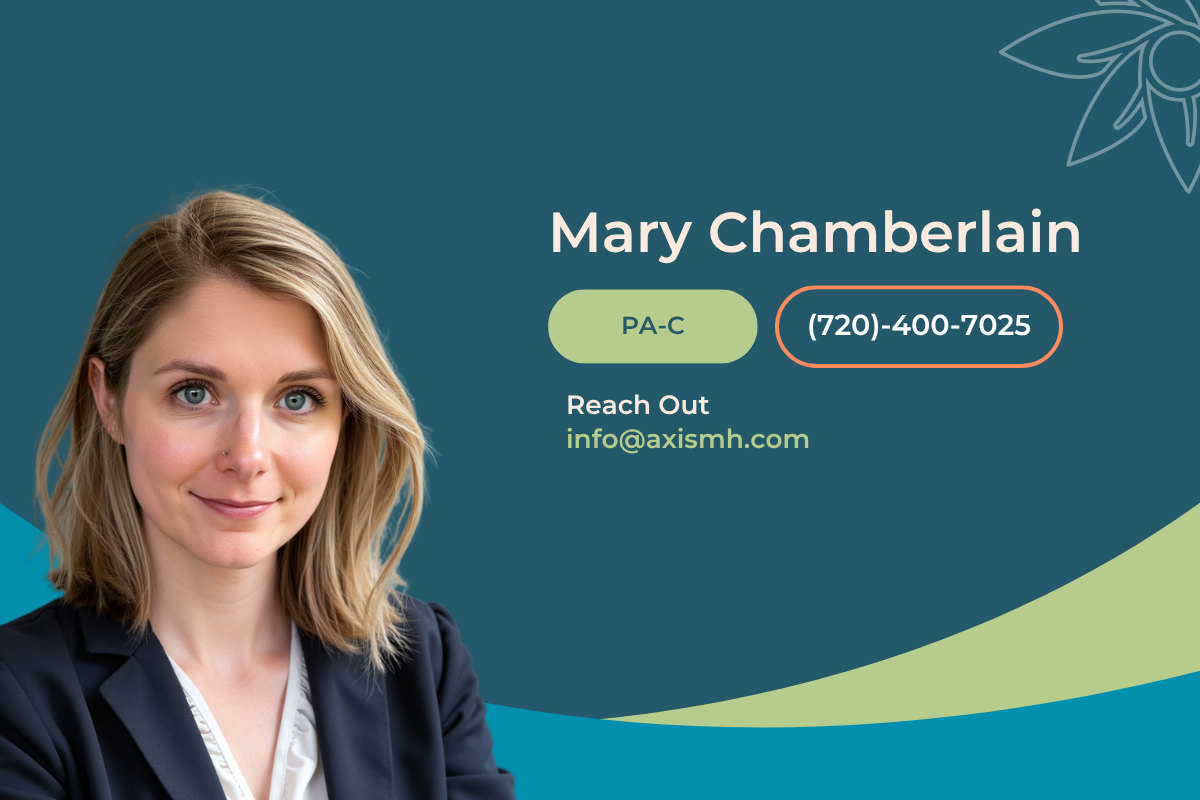
Mary Chamberlain, PA-C, a board-certified Physician Assistant with specialized training in integrative psychiatry, works specifically with patients whose depression hasn’t responded to traditional medication approaches. At Axis Integrated Mental Health in Greenwood Village, she combines psychiatric medication management with advanced interventional treatments including TMS therapy and Spravato (esketamine) treatment—modalities that work through entirely different mechanisms than standard antidepressants.
The Problem Most Psychiatrists Won’t Name Directly
Traditional psychiatric care often follows a predictable pattern: try an SSRI, wait 6-8 weeks, adjust the dose, wait another month, switch to a different SSRI, repeat. If that doesn’t work, add a second medication. Then maybe a third. Patients accumulate prescriptions without accumulating improvement.
“I’ve worked in inpatient units, community mental health centers, and outpatient practices,” Mary explains. “What I’ve observed across all these settings is that medication trials can be essential—but there’s a point where adding another antidepressant isn’t the answer. That’s when we need to shift strategies entirely.”
The challenge is that many providers continue medication trials far beyond the point of diminishing returns. Patients feel like they’re failing treatment, when actually the treatment approach isn’t matching their neurobiological presentation. Treatment-resistant depression often indicates that the serotonin-focused mechanisms of traditional antidepressants aren’t addressing the underlying synaptic dysfunction.
This is where integrative psychiatry diverges from conventional practice. Rather than viewing depression as solely a serotonin deficiency, providers like Mary recognize it as synaptic miscommunication—which requires interventions that fundamentally alter neural pathway functioning. That’s exactly what TMS therapy and Spravato treatment accomplish.
How TMS and Spravato Work Differently Than Traditional Antidepressants
Mary’s approach to treatment-resistant depression centers on two evidence-based interventional modalities:
Deep TMS (Transcranial Magnetic Stimulation)
TMS therapy uses magnetic pulses to directly stimulate underactive brain regions associated with depression—particularly the dorsolateral prefrontal cortex. Unlike oral medications that must cross the blood-brain barrier and affect the entire body, TMS targets specific neural circuits.
Mary has specialized training with Brainsway Deep TMS systems, which use deep-reaching magnetic fields to stimulate broader brain regions than traditional TMS. The treatment involves daily 20-minute sessions over 4 weeks and twice a week sessions for an additional 8 weeks. Patients remain fully awake, don’t require anesthesia, and can drive themselves to and from appointments.
“What surprised me most when I started working with TMS was how quickly some patients notice improvement,” Mary notes. “We’re not talking about the 6-8 week wait typical with antidepressants. Some patients report changes in energy and motivation within the first two weeks.”
Spravato (Esketamine) Treatment
Spravato represents an entirely different mechanism: it’s an NMDA receptor antagonist that works on glutamate pathways rather than serotonin. This matters because glutamate is the brain’s primary excitatory neurotransmitter, directly involved in synaptic plasticity and neural network formation.
The treatment involves self-administered nasal spray in a supervised medical setting. Patients remain for two hours of monitoring after each dose. Treatment begins with twice-weekly sessions, then transitions to weekly or less frequent maintenance dosing based on response.
“Before working directly with integrative mental health techniques like Spravato and TMS, I was skeptical about their effectiveness,” Mary admits. “Now that I’ve seen my patients’ recovery firsthand, I can’t imagine not utilizing these tools for treatment-resistant depression.”
The Integration Strategy Most Colorado Providers Miss
Here’s what distinguishes Mary’s integrative psychiatry approach from providers who simply offer TMS or Spravato as standalone treatments: she addresses the behavioral and physiological factors beyond psychiatric intervention.
Specifically, Mary assesses physical activity patterns as a core component of treatment planning. This isn’t generic wellness advice—it’s a clinical strategy grounded in neuroscience. Research demonstrates that regular physical movement enhances neuroplasticity, amplifies antidepressant response, and improves outcomes for patients receiving interventional treatments.
“When I evaluate patients for treatment-resistant depression, I ask how much they’re moving their body,” Mary explains. “Depression often makes movement feel impossible, so we address the neurobiological barriers first through TMS or Spravato. As those treatments begin working, we integrate realistic movement patterns that align with each patient’s current functioning level.”
This might mean a 10-minute walk for someone who hasn’t left their house in weeks, or returning to a previous exercise routine for someone whose depression disrupted their fitness habits. The point isn’t fitness culture—it’s optimizing treatment response through multimodal intervention.
This integration extends to medication management. Mary doesn’t automatically discontinue all antidepressants when starting TMS or Spravato. Instead, she conducts thorough diagnostic assessment to understand which medications provide benefit, which may be interfering with newer treatments, and which simply aren’t contributing to improvement. The goal is precision over proliferation.
What Other Integrative Psychiatry Providers in Colorado Don’t Discuss: The Social Media Factor
Most holistic mental health providers in Denver talk about sleep hygiene, nutrition, mindfulness, and stress reduction. Mary addresses all of these—but she also directly confronts a factor many providers avoid: social media use.
“I think abstaining from or radically limiting social media use can have significant psychiatric benefits,” Mary states plainly. This isn’t generational hand-wringing about “kids these days.” It’s clinical observation about the documented effects of social media on dopamine regulation, attention span, social comparison, and emotional reactivity.
For patients with depression, social media often creates a particularly toxic cycle: the anhedonia and low motivation characteristic of depression lead to passive scrolling, which further dysregulates reward circuits and deepens feelings of inadequacy and isolation. Breaking this pattern doesn’t cure depression, but it removes a significant obstacle to recovery.
Mary doesn’t demand patients delete all apps. She asks them to track their usage, notice how they feel during and after social media sessions, and experiment with radical reduction. Many patients discover that their “downtime” spent scrolling actually depletes rather than restores their energy.
This willingness to address uncomfortable behavioral patterns reflects Mary’s broader clinical philosophy: effective integrative psychiatry requires honest assessment of all factors affecting mental health, even when those conversations feel awkward or countercultural.
Who Benefits Most from Mary’s Approach
Mary works specifically with adults (18+) experiencing:
Treatment-resistant depression: You’ve tried multiple antidepressants without adequate improvement and you’re ready to explore TMS therapy or Spravato treatment.
Complex presentations: You have co-occurring anxiety, PTSD, or other conditions that complicate medication management and require a provider comfortable with diagnostic nuance.
Women’s Depression: Mary completed specialized psychopharmacology training through Postpartum Support International and has extensive experience with pregnancy and postpartum depression.
Chronic depression affecting functioning: Your depression interferes with work performance, relationships, or basic self-care, and you need interventions that produce meaningful change, not just marginal improvement.
Her practice particularly serves patients in Greenwood Village and the Denver Tech Center area, though she works with patients throughout Colorado who need access to advanced integrative psychiatric treatments.
Mary’s Clinical Journey: From Skeptic to Advocate
Mary’s path to integrative psychiatry began during her physician assistant rotations at the University of Alabama at Birmingham. A behavioral health placement revealed not just the complexity of psychiatric illness, but the profound transformation possible when patients receive effective treatment. She’s remained in mental health ever since.
Her early career at Alabama Psychiatry included inpatient consultation services at Brookwood Hospital, outpatient care for specialized populations, and work with geriatric patients in skilled nursing facilities. This breadth gave her exposure to psychiatric illness across the acuity spectrum—from acute crisis stabilization to maintenance care for chronic conditions.
After relocating to Colorado in 2022, Mary joined WellPower (formerly The Mental Health Center of Denver), working in collaborative care teams with case managers, therapists, and pharmacists. This community mental health experience reinforced her understanding that effective psychiatric care requires more than just prescribing—it demands coordination with other providers and attention to social determinants of health.
Joining Axis Integrated Mental Health in 2024 allowed Mary to focus specifically on treatment-resistant depression and advanced interventional modalities. The specialized training in TMS mapping and treatment procedures for both Apollo and Brainsway systems, combined with her Spravato experience, positioned her to serve patients who need more than traditional psychiatric medication management.
Mary holds her Colorado Physician Assistant License, NCCPA certification, Certificate of Added Qualifications (CAQ) in Psychiatry, and DEA licensure. She completed cognitive-behavioral therapy training at the Beck Institute and continues to serve as a clinical preceptor for physician assistant students.
What to Expect Working with Mary
Initial Psychiatric Evaluation
If you decide to proceed, Mary conducts a comprehensive psychiatric evaluation that typically lasts 60 minutes. She’ll review your complete treatment history (including which medications you’ve tried and how you responded), assess current symptoms, explore relevant medical history, and conduct diagnostic clarification.
Mary is known for being thorough—it’s the descriptor patients use most frequently. This means she doesn’t rush through assessments or make assumptions based on previous diagnoses. She’s looking for the clinical details that explain why previous treatments failed and what interventions are most likely to produce meaningful improvement.
Treatment Planning
Based on your evaluation, Mary develops a personalized treatment plan. For patients with treatment-resistant depression, this often includes:
- Evaluation for TMS therapy or Spravato treatment
- Optimization of current medications (which may mean reducing rather than adding)
- Integration of evidence-based behavioral strategies including physical activity planning
- Coordination with therapists or other providers
- Practical recommendations for factors like social media use that affect treatment response
Ongoing Care
Follow-up frequency depends on treatment intensity. Patients receiving TMS therapy have daily sessions over 4-6 weeks with periodic psychiatric check-ins. Spravato treatment begins with twice-weekly sessions, then transitions to weekly or less frequent dosing. Medication management visits typically occur monthly initially, then can be spaced further apart as stability improves.
Mary works with patients to find the visit frequency that provides adequate monitoring without creating unnecessary burden or expense.
Insurance Coverage and Practical Details
Axis Integrated Mental Health accepts most major insurance plans. Both TMS therapy and Spravato treatment are FDA-approved interventions covered by many insurance policies, though specific coverage varies by plan.
During your free consultation, our team provides a detailed insurance benefits guide explaining:
- Your specific coverage for psychiatric services
- Pre-authorization requirements for TMS or Spravato
- Expected out-of-pocket costs including copays and deductibles
- Payment options if you’re using out-of-network benefits
This transparency allows you to make informed decisions about your care without financial surprises.
Next Steps: Schedule Your Free Consultation
If you’re struggling with depression that hasn’t improved despite multiple medication trials, you don’t have to accept that this is as good as it gets. Treatment-resistant depression responds to different interventions—and Mary Chamberlain specializes in exactly those approaches.
Schedule your complimentary consultation by calling Axis Integrated Mental Health at (720) 738-7158 or visiting our website. Our Greenwood Village office serves patients throughout the Denver Tech Center area and broader Colorado region.
Mary is currently accepting new patients and is in-network with most major insurance carriers. Your free consultation includes a review of your insurance benefits and a general cost guideline, so you’ll understand your investment before beginning treatment.