
Mindbloom and Spravato both use ketamine-based approaches for mental health treatment, but they differ substantially in how treatment is delivered, monitored, and regulated.
Mindbloom provides prescribed ketamine for use at home, with treatment supported remotely and a designated peer monitor present during dosing. This model may appeal to people who prioritize convenience and prefer receiving treatment at home rather than traveling to a clinic.
Spravato (esketamine) is an FDA-approved nasal spray administered only in a certified healthcare setting under the Spravato REMS program. Patients self-administer the medication in the clinic and are monitored by healthcare professionals for at least two hours afterward. Monitoring includes blood pressure and observation for potential side effects such as sedation, dissociation, or changes in vital signs.
At Axis Integrated Mental Health, Spravato treatment is offered at locations in Denver, Denver Tech Center, Boulder, and Westminster. A clinical team checks patients before treatment, monitors their response during the session, and continues observation during the required post-dose monitoring period.
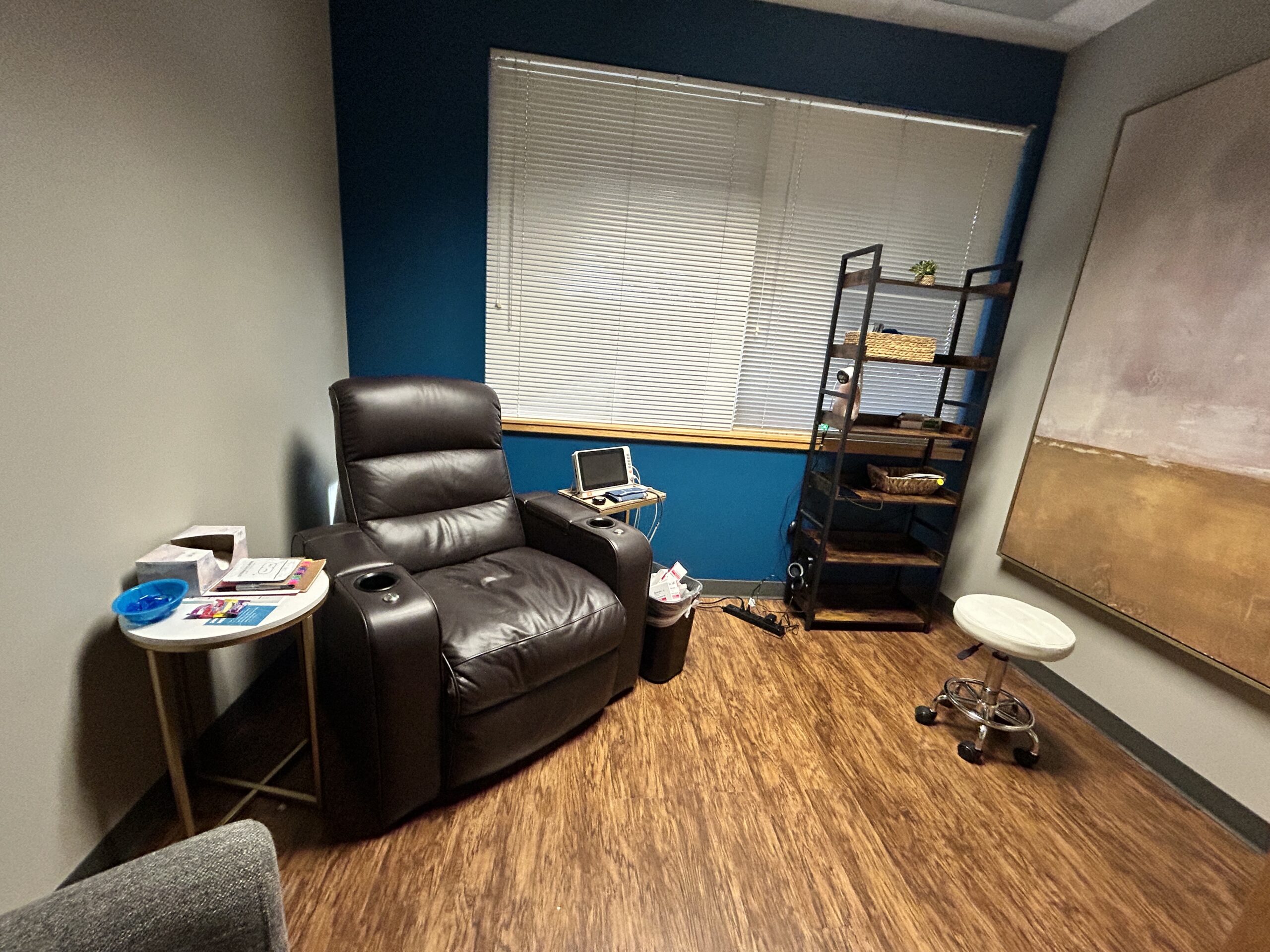
The treatment environment is also designed for comfort during the approximately two-hour visit. Depending on the location, patients may use a zero-gravity chair, weighted blanket, eye mask, and low lighting while receiving treatment.
Another important distinction is regulatory status. Spravato is FDA approved for specific depressive disorders and is distributed through a REMS safety program. Compounded ketamine prescribed for psychiatric use, including formulations used at home, is not FDA approved for the treatment of psychiatric disorders.
Clinical studies of esketamine have reported meaningful improvement for some patients with treatment-resistant depression, although individual outcomes vary. Research has reported response and remission rates in patients receiving esketamine-based treatment, making treatment setting, safety monitoring, cost, insurance coverage, and clinical evidence important factors to compare when considering the two approaches.
Where do Mindbloom and Spravato Ketamine overlap?
People compare Mindbloom and Spravato because both use ketamine’s mechanism to help with depression that hasn’t responded to standard medication. Both work on NMDA receptors, both can produce fast relief (sometimes within days), and both are meant to be paired with therapy or an antidepressant for lasting results.
They both also require a psychiatric evaluation before you start, both space sessions out over weeks instead of dosing daily, and both promise a different route than the SSRI cycle you’re probably tired of. That surface-level overlap is why the comparison feels close. Underneath, the two are very different products.
What’s the real difference between Mindbloom ketamine therapy and Spravato ketamine therapy?
Here’s a side-by-side look at the five differences that may shape your outcome.
| Factor | Mindbloom (at-home) | Spravato (in-clinic) |
|---|---|---|
| Convenience | Sessions at home; no travel; you dose alone with a peer monitor | Twice-weekly in-clinic visits for the first month, then weekly; driving prohibited until the next day |
| Cost | Roughly $89 to $200 per session out of pocket; not covered by insurance | Often as little as $10 per session with commercial insurance with medication paid for by Spravato With Me savings card, which will eventually cover your deductible and out of pocket max; covered by most Colorado plans. |
| Safety | Compounded ketamine, no on-site medical staff; FDA has warned about at-home compounded ketamine risks | FDA-approved under a REMS safety program; provider monitors vitals for 2 hours after each dose |
| Outcomes | Peer-reviewed data shows about 62% symptom reduction and 28% full remission after 4 sessions* | Real-world data shows 79.4% efficacy rate and 52.7% remission rate |
| Long-term stability | Ongoing cost is fully out of pocket; hard to sustain for maintenance | Insurance-covered maintenance makes long-term care realistic |
*Study has noted limitations.
Read: Is Esketamine and Ketamine the same thing?
What are the pros and cons of Mindbloom ketamine therapy?
Pros:
- No travel or waiting room; you dose in your own space
- Faster initial signup than most in-clinic programs
- Lower per-session cost
- Familiar setting may feel less clinical for some people
Cons:
- Uses compounded ketamine, which the FDA has warned about for at-home use without medical monitoring.
- No on-site clinician if blood pressure spikes, dissociation intensifies, or you have a bad reaction. Mindbloom is currently being sued for wrongful death.
- Not covered by insurance, so the full cost is out of pocket.
- Eligibility is narrow; the program excludes people with bipolar I, active psychosis, and other conditions that require closer oversight.
- At-home ketamine may be banned, and some states have already started taking action.
What are the pros and cons of Spravato ketamine therapy?
Pros:
- The only FDA-approved ketamine-based nasal spray for treatment-resistant depression, approved in 2019 and again in 2020 for major depression with suicidal ideation.
- Efficacy rate of 79.4% and 57.3% remission rate across clinical trials, with even higher figures in real-world settings.
- Covered by most Colorado insurance plans and offset by manufacturer savings card often brings your cost down to as little as $10 per session after deductible is met.
- High safety profile. Every dose is supervised in-clinic under the FDA’s REMS safety program, with 2 hours of vitals monitoring afterward.
Cons:
- Requires twice-weekly in-clinic visits for the first month, then weekly, so it takes time
- You cannot drive after a session and need a ride home
- Common short-term side effects include dissociation, dizziness, and nausea, though they resolve quickly
Read more: Is Spravato Worth it?
Mindbloom vs Spravato: Head-to-head
If you strip everything else away, the choice comes down to three questions. Which one is safer? Which one costs less over a year of treatment? And which one has the evidence to back it up?
- Safer: Spravato. It’s the only version of ketamine the FDA has approved for depression, and every dose is supervised. While some at-home ketamine providers point to ketamine’s established safety profile, that evidence is largely based on use in supervised clinical settings.
- Cheaper long term: Spravato, if you have insurance. Mindbloom’s $89 to $200 per session adds up fast when you multiply by 6, 12, or 18 sessions with zero insurance help. A commercially insured Spravato patient at Axis can pay as little as $10 per visit, use the savings card to cover their deductible and out of pocket max and reduce medical bills overall.
- Better evidence: Spravato. It has multiple Phase 3 trials, real-world data across thousands of patients, and an FDA approval built on that evidence.
Mindbloom wins on one thing: convenience. If in-clinic care simply isn’t accessible where you live, at-home ketamine may be your only option. But if you’re within driving distance of Denver, Boulder, DTC, or Westminster, the math tips heavily toward Spravato Ketamine Treatment.
Read: Spravato Essentials Checklist for Your First Session
Who is a good fit for Mindbloom ketamine therapy?
At-home ketamine may make sense if:
- You live somewhere without a certified Spravato-REMS clinic nearby
- You strongly prefer a low-dose at-home approach and understand the trade-offs
- You’ve already checked and confirmed your insurance won’t cover Spravato at any local clinic
- You’re medically low risk (no cardiovascular issues, stable psychiatric history, no bipolar I or psychosis)
Who is a good fit for Spravato ketamine therapy?
Spravato is the better call if:
- You’ve tried 2 or more antidepressants and still feel depressed
- You want an option with FDA approval and published evidence behind it
- You care about safety monitoring during and after each dose
- You want the best chance at insurance coverage
- You may have medical risk factors like elevated blood pressure or a cardiovascular history that needs closer evaluation
- You have comorbid conditions like anxiety, PTSD, or Perimenopausal Depression that a psychiatric provider can manage alongside your Spravato care
Why is Spravato the smarter choice for most people?
Spravato is what happens when a ketamine-based treatment gets built the way medicine is supposed to be built. It’s approved by the FDA, run under a formal safety program, covered by insurance, delivered by a board-certified clinician, and backed by strong clinical evidence.
You get:
- Insurance coverage. Most commercial plans. Axis handles prior authorization for you and can often get your cost down to $10 per session.
- Safety. Your vitals are monitored during and after every dose. If your blood pressure spikes or dissociation runs deep, a clinician is right there.
- FDA guardrails. Every clinic offering Spravato has to be REMS-certified. The dose is standardized. There’s no guessing.
- In-clinic environment. Zero-gravity chair, weighted blanket, eye mask, low lighting. The environment is set up to help the medicine work.
- Multi-condition support. Your provider can coordinate Spravato with therapy, other medications, and treatments like Deep TMS if that makes sense for you.
What Patients Say
Patients often reflect on how treatment has changed their ability to be empathetic, which has positively improved their mental health. One Axis patient states:
Listen to more patient videos and learn more about our program at our new patient center.
How much will Spravato actually cost you?
Cost depends on your insurance plan, your deductible, and where you are in the year. That’s why Axis built a tool that does the math for you.
Get Your Spravato Ketamine Therapy Total Estimate
Important: This is an estimate only, not a guarantee or full benefits investigation. Actual costs depend on your specific plan and claim processing. You are not required or encouraged to book services with Axis based upon this calculator. The calculator is provided as a certain mental and behavioral health concerns.
FAQs
What is the difference between Mindbloom and Spravato?
Mindbloom is an at-home ketamine program that ships you compounded ketamine tablets you take alone with a peer monitor. Spravato is an FDA-approved esketamine nasal spray given inside a certified clinic under medical supervision, with 2 hours of vitals monitoring after each dose. Spravato is covered by most insurance plans; Mindbloom is not. Learn more about Spravato at Axis.
Can I use insurance to pay for Mindbloom or Spravato?
Spravato is covered by most Colorado commercial insurance plans and by Colorado Medicaid. Many Axis patients pay as little as $10 per session after insurance and the Spravato with Me Savings card program covers med costs and the maximum out of pocket for your plan. Mindbloom does not accept insurance and is fully out of pocket. To see what your plan covers, use the Axis Spravato calculator.
How safe is at-home ketamine therapy compared to Spravato?
Spravato is delivered under an FDA-required safety program called REMS, with vitals monitored during and after every dose. The FDA has publicly warned that compounded ketamine used at home without a healthcare provider present may put patients at risk for serious adverse events, including blood pressure spikes and deep dissociation. In-clinic Spravato is the safer route by a wide margin.
What are the qualifications for Spravato treatment?
You typically qualify for Spravato if you’re 18 or older, have a diagnosis of major depressive disorder, and have tried at least 2 antidepressants without adequate relief. Some plans also cover Spravato for major depression with acute suicidal ideation. Axis handles the prior authorization paperwork for you. See our Spravato page for full eligibility details.
How long does it take to feel better on Spravato?
Some patients feel a shift within 24 hours of the first dose. Most people notice meaningful improvement within the first 4 weeks of twice-weekly sessions and long-term outcomes continue to improve during the maintenance phase.
Ready to see if Spravato is right for you?
Serving patients across Denver, Denver Tech Center, Boulder, Westminster, and nearby communities including Lakewood and Thornton, Axis Integrated Mental Health makes advanced depression treatment accessible.
- Schedule online: axis.app.stitchfinapp.com
- Call or text: 720-400-7025
- Check your insurance: axismh.com/check-my-coverage/